







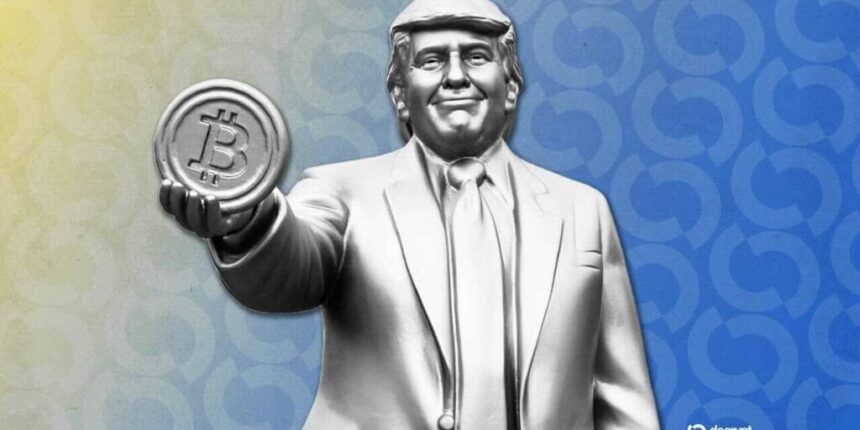
A striking new monument has emerged in Washington, D.C., as a 12-foot golden statue depicting former President Donald Trump clutching a Bitcoin was unveiled outside the U.S. Capitol. The timing of this spectacle coincided with a significant monetary policy day in which the Federal Reserve announced a quarter-point cut in interest rates, merging the realms of politics and cryptocurrency in a dramatic display.
Funded by the creators of the Solana meme coin DJTGST, which recently saw a market cap surge to approximately $2.4 million, the statue serves as a provocative statement on the intersection of government currency and digital financial innovation. Hichem Zaghdoudi, a representative for the project, expressed that the installation was intended to spark dialogue about the future of government-issued currency and embody the connectivity between modern politics and financial advances. Zaghdoudi referred to the piece as a symbolic “thank you” to Trump, highlighting what supporters see as his contributions to the widespread adoption of Bitcoin since his presidency began anew in January.
While supporters view the statue as a tribute to Trump’s perceived pro-Bitcoin leadership, critics have lambasted it as a superficial arrangement that overshadows significant financial and political discussions. Cultural analysts have drawn comparisons between the golden statue and religious iconography, questioning whether such displays trivialize the complexities at play. According to some commentators, the attention-grabbing nature of the statue might be more memorable than any substantive policy changes.
Responses on social media reflected this division, with many Reddit users mocking the statue and calling it cringeworthy, likening Trump to a mascot for a breakfast brand. Others, however, have expressed admiration for the boldness of the installation. The contrasting sentiments highlight the polarized views surrounding both Trump and the evolving landscape of cryptocurrency.
Economists caution that such theatrical displays are indicative of broader issues regarding political influence on monetary policy. A recent survey of 94 economists from the U.S. and Europe indicated a growing concern that external pressures on the Federal Reserve could undermine its independence, potentially leading to inflationary risks and diminished trust in U.S. financial stability. The timing of the statue’s unveiling, coinciding with the Fed rate cut, has been interpreted as a reflection of the increasing intertwining between political spectacles and institutional integrity.
Although the statue was only temporarily displayed from 9 a.m. to 4 p.m., its controversial impact continues to resonate, leaving behind a vivid snapshot of the current mix of politics, economics, and cultural dynamics in the digital age. The debate ignited by this audacious installation seems poised to linger beyond its physical presence, challenging observers to contemplate the implications of such public expressions in the ever-evolving discourse surrounding currency and governance.


