









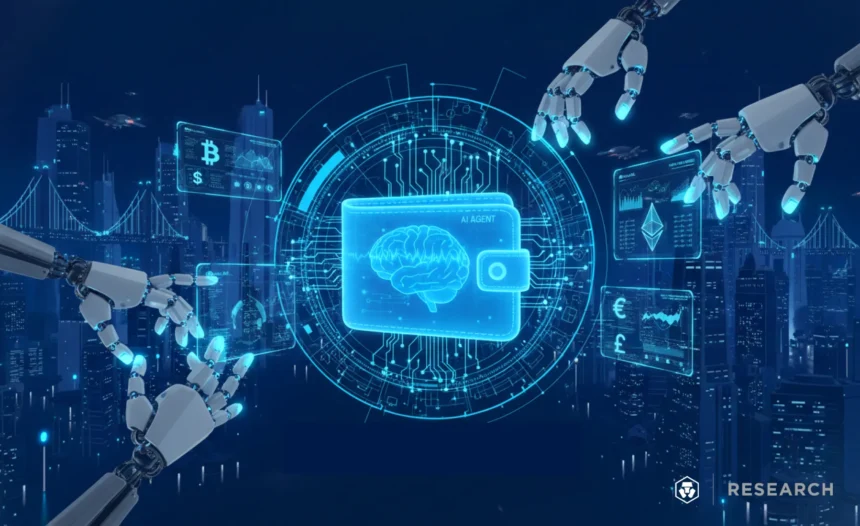
In 2026, the financial landscape is poised for a transformative shift toward a machine-native economy, characterized by autonomous wallets that can self-identify, build reputations, and execute payments without human intervention. This transition is facilitated by the integration of three core protocols that redefine the interaction between decentralized systems and AI agents: the ERC-8004, x402 Protocol, and EIP-7702.
The ERC-8004 standard, also known as “Trustless Agents,” establishes a comprehensive framework for the identity, reputation, and validation of AI agents through three distinct on-chain registries. Each agent is assigned a unique “AgentID” via the Identity Registry, which allows for the tracking of an agent’s history across diverse blockchain networks. This portable identity system enhances cross-protocol functionality, eliminating the opaque nature of previous AI applications.
The Reputation Registry quantifies agent reliability using a score reflecting feedback backed by verifiable economic transactions. By employing cross-references from the x402 protocol, it mitigates the risk of “Sybil attacks,” reinforcing the link between economic activity and reputation. Meanwhile, the Validation Registry enables independent verification of an agent’s executed strategies, utilizing mechanisms such as zero-knowledge proofs and trusted execution attestations.
Complementing these identity solutions, the x402 Payment Protocol revives the HTTP 402 status code to facilitate account-free, high-frequency micropayments. This system allows agents to pay for services seamlessly, enabling instantaneous transactions for various resources without the need for subscriptions or logins. The architecture features a “Facilitator” service that verifies and processes these transactions, significantly enhancing the efficiency of micro-level financial interactions.
As of early 2026, the x402 protocol has successfully processed over 162 million transactions, showcasing its capability as a robust settlement layer. However, it experienced challenges including unsustainable relay economics and latency issues due to a two-phase settlement model that separates verification from transaction execution, hindering rapid M2M network demands.
Despite these setbacks, the ecosystem is on an upswing, driven by a renewed focus on addressing architectural shortcomings with x402 V2. Meanwhile, the EIP-7702 framework enhances user interactions by allowing traditional wallets to perform sophisticated smart contract functions, like batch transactions and gas sponsorships, transforming how users engage with DeFi platforms.
The “Golden Age” roadmap from Cronos is centered on developing the necessary infrastructure to support these advancements. By focusing on high-performance rails, agentic primitives, and wallet interoperability, Cronos aims to create an environment conducive to the deployment of intelligent financial systems. Recent updates have successfully reduced transaction times and costs, facilitating the high-frequency settlements essential to the agentic economy.
This evolution presents several implications for the financial sector. A significant value migration is occurring as traditional intermediaries lose their competitive advantages. The rise of verifiable performance histories for financial algorithms could create new markets driven by a transparent and accountable financial intelligence framework. Additionally, the permissionless nature of cryptocurrency and its structures present a definitive advantage for high-frequency micropayments when compared to traditional finance.
Challenges remain, however, particularly concerning security. Risks such as prompt injection attacks and identity hijacking pose threats to the integrity of the agentic economy. To counter these vulnerabilities, strategies such as multisig governance and sandbox execution environments are being implemented.
In conclusion, the transition towards a machine-native economy marked by autonomous wallets and intelligent agents signals an era where finance is increasingly democratized. By breaking down traditional barriers and introducing sophisticated economic frameworks, the Cronos and Crypto.com ecosystems offer retail investors access to advanced financial strategies previously reserved for institutional players, heralding a new age of financial intelligence and inclusion.