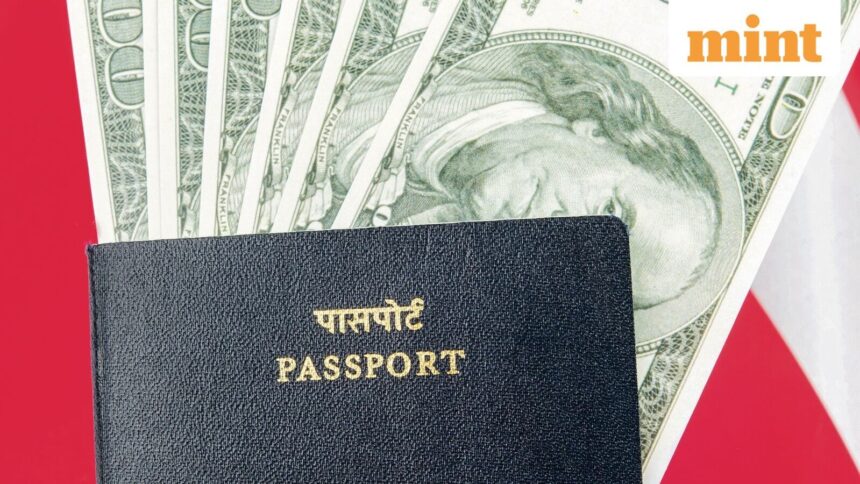
On Friday, President Donald Trump implemented a significant shift in U.S. immigration policy by signing an executive order mandating a $100,000 application fee for H-1B visa petitions. This move has drawn sharp criticism from industry leaders and lawmakers, who warn that it will adversely affect the IT sector and the broader U.S. economy.
In his proclamation titled “Restriction on entry of certain nonimmigrant workers,” Trump argued that the H-1B visa program has been misused to displace American workers in favor of lower-paid foreign labor. He posited that this abuse not only threatens domestic employment but also poses a national security risk. Trump stated that U.S. law enforcement has identified issues such as visa fraud and money laundering associated with outsourcing companies reliant on H-1B visas.
Critics have voiced strong objections to the new fee implementation. Congressman Raja Krishnamoorthi characterized the hike as a “reckless attempt” to exclude skilled workers who have historically contributed to American innovation and economic growth. He emphasized the need for a modernized immigration system that attracts global talent rather than deterring it, especially as other nations compete for the same workforce.
Ajay Bhutoria, a former advisor to President Joe Biden, expressed concern that this fee increase could critically hinder innovation by imposing unprecedented barriers on the H-1B program, which has been a key resource for attracting top talent. He warned that such a leap from the current fees, which range from $2,000 to $5,000, could significantly burden small businesses and startups that depend on diverse expertise.
Khanderao Kand from the Foundation for India and Indian Diaspora Studies labeled the decision as “unfortunate” and predicted it would have damaging effects on the U.S. tech industry. He highlighted that the high fee could limit access to skilled STEM graduates who might otherwise contribute to innovation, particularly in smaller firms facing growing challenges from automation and tariffs.
In the wake of the announcement, major companies have begun adjusting their operations. Microsoft has encouraged H-1B and H-4 visa holders currently outside the U.S. to return before a forthcoming September 21 deadline. JP Morgan has advised its H-1B employees to refrain from international travel until clearer guidance is provided.
The financial markets responded to the news with declines in shares of companies heavily reliant on H-1B workers. Cognizant Technology Solutions saw a nearly 5% drop, while Indian tech firms such as Infosys and Wipro reported declines between 2% and 5% in their U.S.-listed shares. Many tech and consulting firms have withheld public comments regarding the policy change as they assess its implications.
Overall, the executive order marks a significant escalation in the ongoing debate over immigration and its impact on U.S. labor markets, raising questions about the future of the H-1B visa program and its crucial role in the American technology landscape.