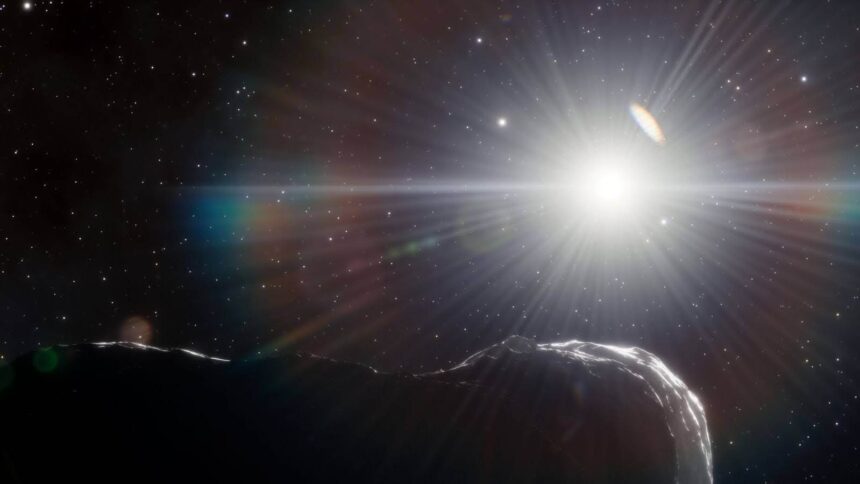
The space science community has witnessed a unique event nearly a year ago when an asteroid known as 2024 PT5 entered Earth’s orbit, circling our planet for nearly two months. While scientists typically monitor such celestial bodies due to their potential risks, the growing interest in asteroids is fueled not only by their hazard potential but also by their wealth of precious metals. These metals, including platinum, cobalt, iron, and even gold, could be worth billions, drawing the attention of space entrepreneurs and scientists who are preparing for future asteroid captures and mining opportunities.
Asteroids primarily orbit the sun within a region known as the asteroid belt, located between Mars and Jupiter. NASA has estimated the total worth of metals in these asteroids to be around $100 million per person on Earth, with mining just ten of the most profitable asteroids potentially yielding as much as $1.5 trillion. The pivotal question remains: Can we effectively access these valuable resources?
Asteroid 2024 PT5, which originated from the Arjuna asteroid belt, was informally dubbed a “mini-moon.” Although it did not complete a full orbital cycle around Earth, it nonetheless mirrored our moon’s path overhead and was found to contain rare earth metals. Despite previous missions like NASA’s OSIRIS-REx and Japan’s Hayabusa2 successfully returning asteroid samples, the cost of extracting these materials has historically been prohibitive, ranging from $10 million to $150 million per gram.
One significant challenge in asteroid mining is the distance from Earth to the asteroids themselves. Fuel and equipment costs can escalate quickly, making distant mining ventures financially unfeasible. However, mini-moons like 2024 PT5 present a more accessible mining target. Their proximity has prompted numerous space mining startups to strategize for benefit from upcoming asteroid visits.
Joel Sercel, founder of TransAstra, has expressed confidence in capturing such mini-moons. Sercel has articulated plans to simply fly to an asteroid, capture it, and establish it in a stable orbit, turning it into a permanent resource in space. Nevertheless, the consensus among experts is that mini-moons are rare; fewer than ten have been detected in the past decade, raising questions about the practicality of future mining endeavors.
Various environmental challenges accompany asteroid missions. Temperature extremes and radiation complicate potential expeditions, as highlighted by Mustafa Hassanalian, an associate professor at the New Mexico Institute of Mining and Technology. The task of locating asteroids remains formidable; however, advances in detection technology from the Vera C. Rubin Observatory could enhance future findings.
Currently, approximately a dozen small asteroids orbit Earth, but many lack sufficient size to make mining attempts worthwhile. Mini-moons are recognized as ideal candidates for feasible extraction efforts. Despite their potential, the logistics of operating in space create complexity, with scientists facing unique issues such as asteroid rotation, which can hinder landing efforts.
Companies like Tethers Unlimited, conceptualized by researcher Rob Hoyt, explored innovative methods for capturing asteroids without landing, proposing the use of nets to ensnare asteroids and facilitate their transport back to Earth. Although funding for such initiatives has dwindled, the vision persists.
TransAstra has pivoted towards employing “concentrated sunlight” to facilitate asteroid mining by wrapping asteroids in large plastic bags to extract their water and leave behind precious metals. Though the company was unable to exploit the opportunity with 2024 PT5, it is awaiting future celestial visitors.
As advances in exploration continue, NASA plans to launch the Psyche probe to investigate a metal-rich asteroid in 2029. This mission could herald the dawn of an interstellar mining industry, with projections placing the worth of asteroid 16 Psyche in the quadrillions, a figure that could drastically affect global economies if materials were brought to Earth in large quantities.
However, the viability of asteroid mining is limited by significant challenges, not least of which is securing the massive investments required to transition from theoretical exploration to implementation. With past efforts experiencing setbacks and the dwindling fortunes of certain companies, the future of asteroid mining remains uncertain, teetering between ambition and the complexities of practical execution.