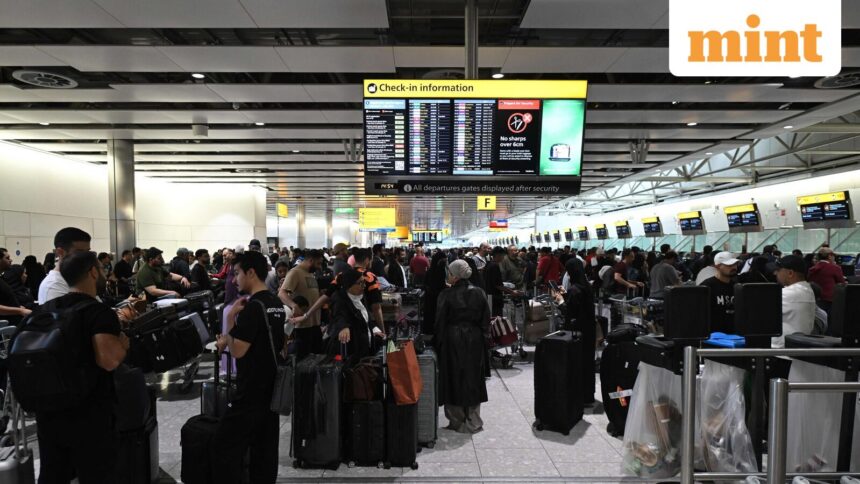
A cyberattack on a US-based software system provider has caused significant disruptions at several European airports, entering its second consecutive day on Sunday. The breach, which began late Friday, predominantly impacted electronic check-in systems, leading to numerous flight cancellations and delays across various airlines. The compromised software is operated by Collins Aerospace, a key provider whose systems are essential for passenger check-in, boarding pass printing, baggage tagging, and luggage dispatch.
Brussels Airport has emerged as the most heavily affected facility, with airlines compelled to cancel nearly 140 departing flights scheduled for Monday, representing about half of the total 276 flights. The airport management made this decision due to Collins Aerospace’s inability to provide a secure updated version of their check-in system in a timely manner. Consequently, cancellations and delays at Brussels Airport are expected to persist as manual check-in processes are mandated.
In contrast, while departure boards at London’s Heathrow and Berlin’s Brandenburg airports showed signs of recovery on Sunday, Brussels Airport continued to struggle with the ramifications of the attack. Collins Aerospace, a subsidiary of RTX Corp., publicly acknowledged a “cyber-related disruption” on Saturday and committed to resolving the issue. The company noted that the impact was confined to electronic customer check-in and baggage drop operations but could be somewhat alleviated through manual check-in methods.
Ihsane Chioua Lekhli, a spokesperson for Brussels Airport, clarified that the cyberattack had solely affected computer systems at check-in desks, leaving self-service kiosks operational. Thanks to the deployment of additional staff and the functionality of self-bag drop and online check-in services, the airport managed to maintain 85% of scheduled departures over the weekend.
The disruptions were not limited to Brussels, as major European airports including Berlin and London experienced similar challenges late Friday. Airline staff were forced to resort to creative solutions like handwriting boarding passes or using backup laptops. Notably, many other European airports remained unaffected by the attack, and the Indian government confirmed that operations in its airports had not been disrupted.
The European Commission, which oversees the executive branch of the 27-nation EU, reassured that aviation safety and air traffic control remained intact amidst the chaos. There were no indications of a widespread or severe cyberattack affecting the broader aviation network.
In light of the ongoing situation, the affected airports urged passengers to verify their flight statuses before heading to the terminals and to consider alternative check-in methods. A statement from Heathrow expressed regret for the delays faced by passengers, emphasizing that collaborative efforts with airlines allowed the majority of flights to continue operating. A notification on Brandenburg Airport’s website warned of longer waiting times due to the systems outage and encouraged the use of online check-in, self-service options, and fast bag drop services.