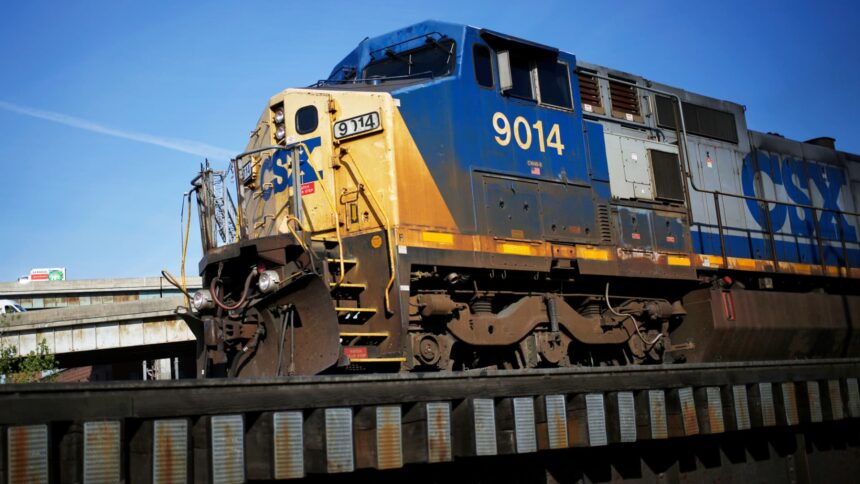
In a surprising leadership shakeup, railroad operator CSX announced that Joe Hinrichs is stepping down as chief executive after three years, with Steve Angel stepping into the role. Jim Cramer of CNBC has voiced his skepticism regarding the decision, suggesting that it raises more questions than it answers about the future of the company and the broader railroad industry.
Cramer expressed his discontent during a segment on “Squawk on the Street,” where he labeled the board’s decision as an overreaction, pointing to Hinrichs’ successful tenure, which saw CSX shares rise 28.3% on a total return basis since he took command. In comparison, other major rail operators have seen varying returns, with Canadian Pacific Kansas City up 10.3%, Union Pacific rising 23.6%, and Norfolk Southern jumping 46.4%.
The board’s decision to replace Hinrichs comes amid heightened speculation about potential consolidation within the railroad sector. Cramer suggested that the board may have panicked, prompted by ongoing discussions around mergers, particularly after Union Pacific unveiled an $85 billion acquisition offer for Norfolk Southern. If this deal is approved, it would create the first coast-to-coast operator in the U.S., igniting speculation about further industry tie-ups involving CSX and Berkshire Hathaway’s BNSF.
While Cramer acknowledged his respect for incoming CEO Steve Angel, who previously led Linde, he emphasized that the focus should be on CSX’s board’s decision-making rather than on Angel’s capabilities. Cramer’s comments reflect a broader concern that CSX might be succumbing to external pressures to pursue aggressive mergers rather than focusing on internal growth strategies.
Compounding this situation, activist investor Ancora urged CSX in mid-August to either ‘make a deal’ or replace Hinrichs. However, Berkshire Hathaway CEO Warren Buffett stated that he was not interested in BNSF acquiring another railroad and instead advocated for collaborative efforts to enhance operational efficiency.
Meanwhile, CSX has partnered with BNSF to offer coast-to-coast service, leveraging strengths from both companies—CSX with its lines concentrated on the East Coast and Midwest, while BNSF dominates the western regions. Following this, CPKC has publicly stated it is not inclined to pursue immediate consolidation, insisting that current industry structures are adequate for operation.
Before his departure, Hinrichs pointed out significant operational issues like bottlenecks during interchanges—the time it takes to transfer freight between different carriers—which could be improved without the need for mergers. He stated that the growing demand from customers is for a seamless experience, suggesting that collaborative efforts might yield better results than consolidation.
Reflecting on recent interviews with Hinrichs, Cramer noted that BNSF’s ability to consider acquiring CSX is essential for any potential deal. Yet, with CSX’s future leadership now uncertain, market observers remain watchful for the direction the company will take under Angel’s leadership—and whether it will pursue mergers or focus on optimizing its existing operations.