Shares across Asia experienced a mixed performance on Wednesday, influenced by notable economic reports and looming political uncertainties. Chinese markets remained closed for a weeklong National Day holiday, creating a quieter atmosphere in the region.
Japan’s Nikkei 225 index fell 1.2% to 44,411.26 despite a report from the Bank of Japan (BOJ) indicating a slight improvement in business sentiment among major manufacturers. This quarterly tankan report heightened expectations that the central bank may soon raise its key interest rate to combat inflation, which has consistently exceeded its target of around 2%. Compounding market concerns, Japan is poised to see a leadership change, as the ruling Liberal Democratic Party is set to select a new leader and prime minister to replace the under-pressure Shigeru Ishiba.
Meanwhile, amidst the holiday closure in mainland China from October 1 to 8, the People’s Bank of China announced plans for a significant 1.1 trillion yuan (approximately $160 billion) reverse repo operation scheduled for October 9. This move aims to inject liquidity into the market, stimulating both consumer spending and business investment.
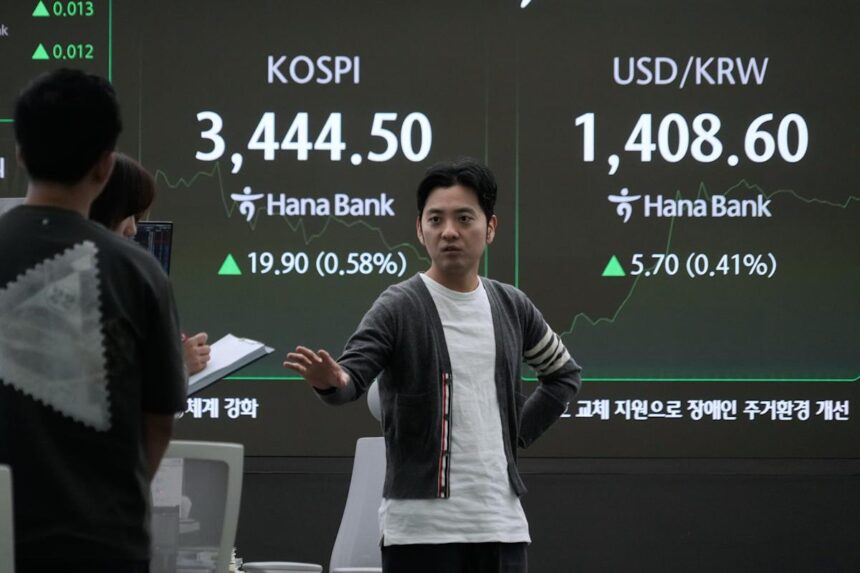
In other Asian markets, South Korea’s Kospi increased by 0.8% to reach 3,450.62, while Taiwan’s Taiex jumped 1.3% on robust buying of semiconductor stocks. Conversely, Australia’s S&P/ASX 200 dipped 0.4% to 8,812.90.
In the U.S., investors appeared to be taking potential government shutdown developments in stride ahead of a midnight deadline in Eastern time. Historically, government shutdowns have had a limited effect on the stock market, and many analysts anticipate a repeat of that scenario this time. Despite the looming uncertainty, the S&P 500 climbed 0.4% to 6,688.46, marking its fifth consecutive month of gains and following a record-setting week. The Dow Jones Industrial Average also rose by 0.2%, achieving an all-time high of 46,397.89, while the Nasdaq composite treaded upward by 0.3% to 22,660.01.
However, the current shutdown bears the potential for greater repercussions, with indications that the administration may pursue widespread federal employee layoffs. The broader stock market has seen a steady ascent since hitting a low in April, driven by optimism that President Trump’s tariffs won’t disrupt global trade and the Federal Reserve’s intentions to lower interest rates to support a slowing job market.
In the bond market, Treasury yields fluctuated but ultimately remained relatively stable amid mixed signals regarding the U.S. economy. One report indicated that consumer confidence has dipped more than economists had predicted, with many attributing this to concerns about the job market and persistent inflation. Another report highlighted a stagnant job market, noting that U.S. employers were posting roughly the same level of job openings at the end of August as the previous month. Wall Street remains hopeful for data that would endorse a balanced job market, keeping the Fed on course for additional interest rate cuts.
The uncertainty surrounding the upcoming job market reports—due to the possibility of a federal shutdown—has caused additional anxiety among investors. The Department of Labor has indicated that its Bureau of Labor Statistics would halt operations during a shutdown, adding to concerns about the accuracy and timeliness of critical labor data. The agency is already facing strain following the recent dismissal of BLS Commissioner Erika McEntarfer and the withdrawal of the nomination of E.J. Antoni to lead the bureau.
In commodity markets, oil-related companies faced downward pressure as crude prices continued to decline, reflecting oversupply concerns. Companies like Baker Hughes saw stocks drop by 3.6%, while Schlumberger fell by 2.1%. Early Wednesday trading indicated that U.S. benchmark crude oil rose to $62.48 per barrel, while Brent crude increased to $66.15 per barrel. The U.S. dollar also strengthened against the Japanese yen, reaching 147.98, and edged up against the euro, which settled at $1.1738.