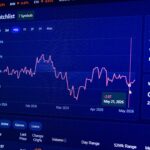
The “Warren Buffett Indicator,” which compares the total value of the U.S. stock market to the size of the U.S. economy, has recently climbed above 200%. At approximately 217%, this measure has raised concerns as it signifies stretched valuations compared to economic output. Buffett previously cautioned that hitting this benchmark is akin to “playing with fire,” indicating heightened risk levels if corporate profits or economic growth fail to keep pace with market expectations.
This indicator operates as a straightforward ratio of total U.S. stock market capitalization, often represented by the Wilshire 5000, relative to U.S. GDP. Buffett has emphasized its value, dubbing it “probably the best single measure” of broad market valuation, which is why it has become closely associated with his name over the past two decades.
The increase above 200% is a reflection of rapid gains in the stock market, primarily driven by large-cap companies and enthusiasm surrounding artificial intelligence (AI). This disparity suggests that stock values have outpaced economic growth, potentially setting the stage for volatility if earnings fail to meet the inflated expectations that such high valuations entail.
In simpler terms, the ratio serves as a “price tag” for the entire stock market in relation to the American economy’s “paycheck.” When the price tag doubles the paycheck, it indicates that market expectations are exceedingly high, making the potential for disappointment even greater. Historically, similar elevated readings have often coincided with subsequent periods of poor stock performance, but identifying the precise timing of a correction can be challenging, as markets may remain overvalued for extended durations.
While the ratio can act as a cautionary signal, it has its limitations. Many large U.S. firms derive significant earnings from international markets, and factors such as interest rates and profit margins play important roles. Furthermore, elevated ratios can persist during long bull markets, which complicates the interpretation of this metric when used in isolation.
The current market landscape is particularly striking, with the total value of U.S. stocks sitting at around 363% of GDP, surpassing the 212% peak seen during the dot-com boom. This climb has been fueled by enthusiasm for AI technologies, escalating valuations of mega-cap stocks, and soaring price-to-earnings ratios, all occurring without commensurate increases in corporate profits.
Experts like David Kelly from JPMorgan Asset Management have highlighted that much of the stock market’s appreciation since the mid-1980s is tied to a rising profit share of GDP and an increase in price multiples, which may no longer be sustainable. This raises alarms, especially in the wake of challenges facing the AI sector and recent trends indicating a slowdown in economic growth, with a GDP increase of only around 1.75% and deteriorating employment data.
Given these circumstances, financial strategists recommend diversifying investments beyond high-flying U.S. mega-cap stocks, suggesting alternative opportunities in international equities and core fixed income assets. However, Kelly remarks that determining the right timing for such adjustments is tricky after a prolonged bull market.
For investors, a reading above 200% serves as a signal that market prices have significantly diverged from economic realities. This disparity heightens the likelihood of a realignment if growth or earnings fall short of expectations. Buffett’s investment philosophy in such an environment emphasizes the pursuit of quality, cash flow, and robust business models, advocating for patience to seize opportunities when they arise rather than chasing already inflated assets.