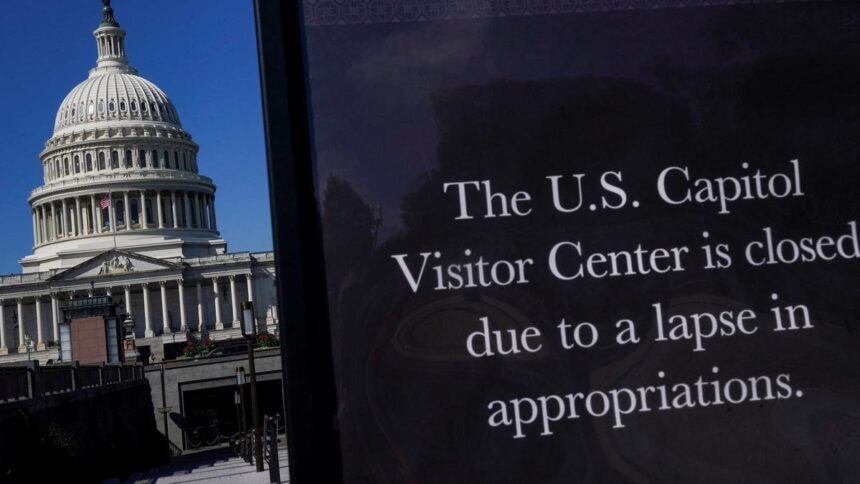
A partial government shutdown has officially begun, raising questions about how long the standoff will last. With predictions ranging from a few days to several weeks, many are turning to prediction markets to gauge likely outcomes. Sites like Polymarket and Kalshi have seen increased activity as users speculate on the duration of the shutdown, with many anticipating a prolonged closure.
Currently, Republicans control both chambers of Congress but will require at least seven Democratic votes to pass any spending bill in the Senate. This requirement has given Democrats significant leverage as they advocate for the continuation and expansion of tax breaks for approximately 24 million Americans who purchase insurance through the Affordable Care Act (ACA). Thus far, Democrats have withheld support for any spending bill that does not address these tax breaks.
Republicans have expressed openness to discussing a solution for the expiring ACA tax breaks but only on the condition of passing a temporary spending bill that would fund the government through November 21. This proposed legislation does not include any modifications to the ACA subsidies, further complicating negotiations.
At present, both prediction markets indicate a likelihood of a longer shutdown. According to Polymarket, users assign a 35% probability that the standoff will last 15 days or longer, with over $200,000 wagered on the potential length of the shutdown. The probability of reopening between October 6 and October 9, as well as between October 10 and October 14, hovers around 28%. A reopening by October 3 to 5 is deemed to have only a 7% chance, with an even slimmer likelihood of returning before October 2.
Kalshi users foresee a shutdown likely exceeding four days, with an 89% chance of lasting more than that period and an 87% probability of extending beyond five days. However, the chances of a closure lasting more than 15 days decrease to 33%. Near-term disruptions appear almost certain for Kalshi users, with shutdowns shorter than three days given better than 90% odds.
These prediction markets operate as platforms for “event contracts,” allowing users to bet on the outcomes of various significant events. Each contract operates similarly to commodity futures, where users can trade bets on yes-or-no propositions regarding potential outcomes. Some experts clarify that while these contract prices reflect collective beliefs about future events, they do not necessarily represent true probabilities.
Polymarket has recently received approval from the Commodity Futures Trading Commission (CFTC) to resume its operations in the U.S., a development that follows previous legal challenges over illegal event-based options. This form of betting, which has faced scrutiny, raises ethical questions about the broader implications of wagering on significant societal events, as highlighted in various discussions and media portrayals.
As negotiations continue, the uncertainty surrounding the potential duration of the government shutdown remains high, with both sides locking horns over key issues that could shape federal funding for the coming months. Whether a resolution can be reached in a timely manner remains to be seen.