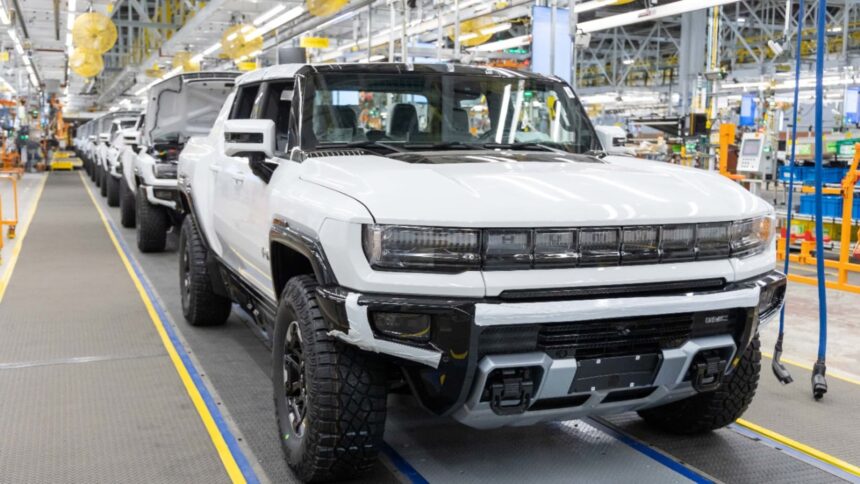
Production is set to commence at the former Detroit-Hamtramck assembly plant following General Motors’ significant $2.2 billion investment to renovate the facility for the manufacturing of all-electric trucks and SUVs. This milestone marks a critical step in GM’s transition toward electric vehicle production.
In related developments, shares of major Detroit automakers experienced an uptick after reports surfaced indicating that President Donald Trump is considering “significant tariff relief” that could significantly benefit U.S. vehicle production. Stocks for General Motors, Ford Motor, and Stellantis (the parent company of Chrysler) rose between 1% to 4% after the afternoon announcement.
According to a report by Reuters, which cited Republican Senator Bernie Moreno of Ohio as well as automotive officials, the proposed changes could “effectively eliminate much of the costs major car companies are paying.” Moreno emphasized that the potential measure signals to global automakers that U.S. final assembly will be encouraged and rewarded.
The anticipated relief may involve extending the current 3.75% tariff offset for an additional five years, along with provisions for U.S. engine production to receive similar relief. This could significantly impact companies with substantial domestic operations, including Ford, Toyota, Honda, Tesla, and GM.
Ford shares reached a new 52-week high, closing at $12.67, reflecting a 3.7% increase. Stellantis’s U.S.-listed shares closed up 3.2% to $10.73, while GM shares rose by 1.3%, ending the day at $60.13. Conversely, Tesla’s stock saw a slight decline of 1.4%, closing at $429.83.
The automotive industry has long been concerned about the implications of Trump’s 25% tariffs on imported vehicles and parts, which have resulted in substantial costs for manufacturers. Ford has previously indicated expectations of approximately $3 billion in tariff-related expenses this year, with initiatives to mitigate about $1 billion of that. GM projected up to $5 billion in gross tariffs, highlighting its potential to avoid roughly 30% of that amount.
Active lobbying efforts have been underway by automakers urging the Trump administration to adjust tariffs, particularly for vehicles produced in the U.S. and those imported from Canada and Mexico. The evolving tariff landscape could dramatically reshape production costs and strategies for these major firms moving forward.