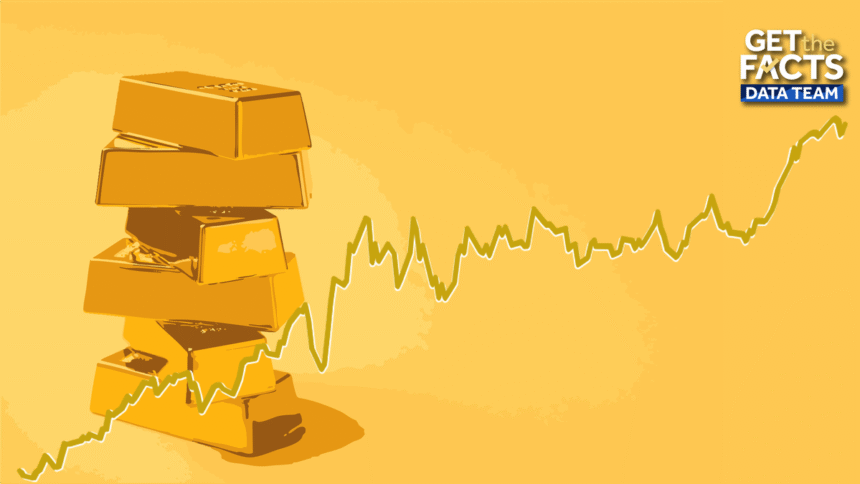
Gold prices are soaring to historic highs, nearing the $4,000 mark, reflecting an astounding 45% increase since the beginning of the year. Starting at $2,669 in January, the precious metal has rapidly gained traction as a safe-haven asset amid increasing economic uncertainty. On Tuesday, the price surge continued as traders anticipated a potential U.S. government shutdown, a trend historically linked to rising gold prices during similar past events.
Gold, often referred to historically as the “currency of kings,” has evolved from a primary item of trade to a crucial safe-haven asset in the modern marketplace. Its unique properties—durability, malleability, and resistance to tarnish—have made it a long-held store of value in various cultures.
Professor Andrea Bubula, a senior lecturer in economic analysis for international affairs at Columbia University, notes that the global financial crisis prompted many countries to diversify their reserves beyond U.S. dollars, increasingly turning to gold. This shift in perspective dates back to the Venezuelan banking crisis in 2009, during which the government’s harsh measures compelled central banks to reassess the security of their assets. “Gold is good because it is typically negatively correlated with markets, so when markets do badly, gold does well,” Bubula explained.
A recent report from the World Gold Council highlights the significant uptick in gold reserves held by central banks, which have doubled in the past three years, reaching 1,000 tons compared to the previous decade’s average of 400-500 tons. Taylor Burnette, research lead for the Americas at the World Gold Council, specified that gold demand typically falls into three categories: jewelry and technology, investors, and central banks, with the current year seeing investors drive the largest demand. Family offices and high-net-worth individuals make up this investor base, often allocating approximately 5% of their portfolios to gold.
Factors like a weaker U.S. dollar and lower interest rates further amplify gold’s attractiveness as a holding. The U.S. dollar index, which began the year at 109.23, has depreciated over 10% in the last nine months as credit-rating agencies downgrade the U.S. government’s financial standing. Gold’s value tends to rise in the face of a declining dollar since it is priced in U.S. currency, leading to a situation where purchasers must pay more dollars to acquire the same amount of gold. Notably, Bubula emphasizes that gold is also becoming more expensive in other currencies, suggesting its special status transcends the exchange rates.
According to the World Gold Council’s second-quarter report, gold demand reached an impressive 1,249 metric tons, over 40 million troy ounces, a 3% yearly increase. Key demand drivers included gold ETF investments, accounting for 170 metric tons, and Asian-listed funds, which added another 70 metric tons. The report indicated that a volatile geopolitical environment and consistent price momentum significantly boosted gold investment flows.
Despite these strengths, there are downsides to investing in gold, such as the costs associated with storage and insurance due to its susceptibility to theft. Unlike stocks, which pay dividends, and bonds that offer returns, gold does not yield interest. Bubula cautioned that while financial assets provide income through dividends or returns, gold serves more as a hedge against potential losses compared to stocks and bonds, which have been in a bearish sentiment according to the AAII Sentiment Survey over the past nine months.
As gold prices continue to accelerate, investors are faced with a complex decision-making landscape influenced by a blend of geopolitical factors, market sentiment, and economic conditions.