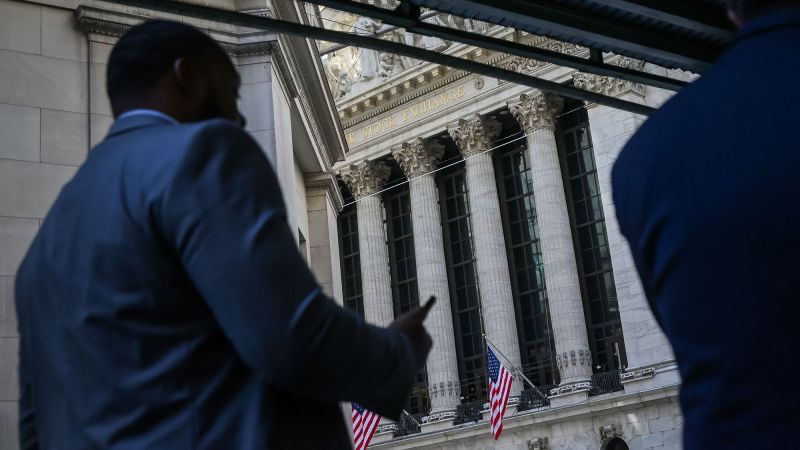
Stocks experienced a mixed close on Friday as investors largely disregarded concerns regarding the ongoing government shutdown. The Dow Jones Industrial Average ended the day up by 239 points, or 0.51%, after reaching a high of 530 points during the session. In contrast, the S&P 500 rose slightly by 0.01%, while the tech-heavy Nasdaq Composite saw a decline of 0.28%.
Recent weeks have seen stock prices rise, buoyed by strong corporate earnings, growing enthusiasm surrounding artificial intelligence, and optimism over potential Federal Reserve interest rate cuts. The Dow’s robust performance on Friday came as a broad rally spread to underperforming sectors, while technology investors opted to take profits. Both the Dow and S&P 500 achieved new record highs.
Historically, government shutdowns have not significantly impacted stock performance, typically being short-lived events that exert minimal long-term economic effects. “History essentially says that government shutdowns have been more headline events than bottom-line-affecting events,” stated Sam Stovall, chief investment strategist at CFRA Research.
Despite the positive close for the Dow, Wall Street is grappling with a government data blackout, which has deprived investors of key economic indicators. The crucial monthly jobs report from the Bureau of Labor Statistics was notably not published and will remain delayed until the government reopens. This lack of essential government data complicates investors’ understanding of the economy while concerns about a weakened labor market and persistent inflation grow.
If the shutdown persists, the absence of government data may put additional pressure on investors as they try to assess labor market health and inflation trends amid rising stock valuations. Mark Hamrick, senior economic analyst at Bankrate, emphasized the poor timing of the shutdown, noting that it coincides with signs of economic fragility.
Various government agencies, including the BLS and the Census Bureau, announced the postponement of data releases until after the government shutdown concludes. José Torres, senior economist at Interactive Brokers, pointed out that the uncertainty generated by the lack of economic data creates challenges in forecasting economic conditions.
Despite this uncertainty, the Dow and S&P 500 reported gains of over 1% for the week, with the former hitting new highs during the initial days of the shutdown. Nevertheless, analysts warn that the omission of the jobs report and potential continued data gaps could present added risks to markets, complicating the Federal Reserve’s economic assessments. “It is more difficult than usual to measure the state of the US labor market,” commented Bill Adams, chief economist at Comerica Bank, highlighting the absence of reliable federal economic indicators.
Keith Buchanan, senior portfolio manager at Globalt Investments, expressed concerns that the market may be underestimating the risks associated with a prolonged shutdown, stating, “We just feel like the market is being a little too sanguine.”
In the meantime, investors and economists are left seeking alternative sources of economic data. Private payroll data from ADP has emerged as a focal point in the absence of the BLS report. A recent release from ADP indicated a loss of 32,000 jobs in September, which fueled speculation that the Federal Reserve might implement rate cuts in October, giving stocks a short-term boost. However, without official government reports, Wall Street lacks a comprehensive view of unemployment trends.
Paul Donovan, chief economist at UBS Global Wealth Management, criticized the reliance on private data as insufficient, describing it as akin to “viewing the economy through a keyhole,” contrasted with the more expansive insights offered by official data.
Looking ahead, Paul Christopher from Wells Fargo Investment Institute suggested that investors should focus on long-term economic drivers rather than the immediate concerns posed by the shutdown. Catalysts, such as a gradual easing of trade policy uncertainty and anticipated Fed rate cuts, are expected to shape stock performance over the next year.
The delayed jobs report is particularly critical for the Fed, which relies heavily on government data to inform its policies. David Seif, chief economist at Nomura, warned that if the shutdown extends, the Fed may find itself operating without crucial economic data before its upcoming interest rate decisions.