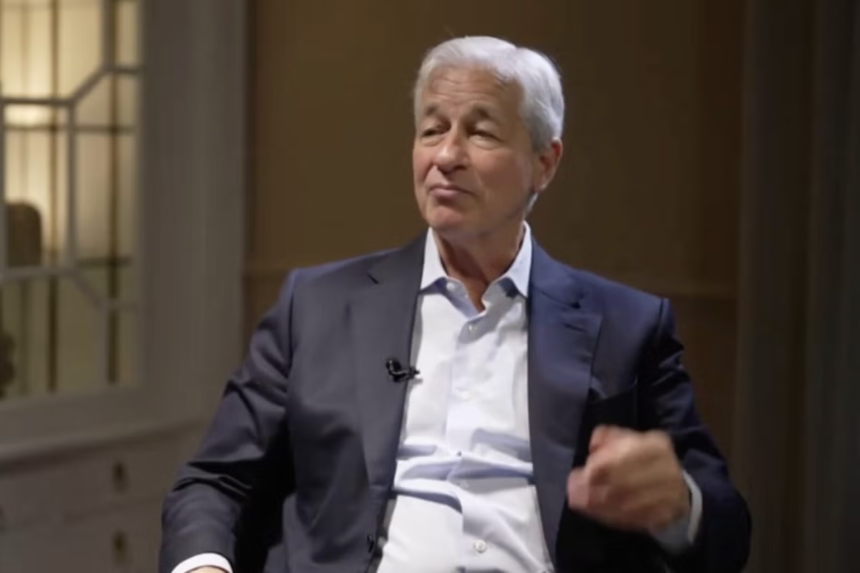
JPMorgan Chase CEO Jamie Dimon has expressed heightened concerns regarding the potential for a U.S. stock market crash, positioning his outlook on the situation as more alarmist than many of his peers in the financial industry. In an interview with BBC’s Business Editor Simon Jack, Dimon discussed the implications of President Donald Trump’s ongoing trade tariffs, reflecting a notable shift from his earlier ambivalence on the matter.
“I am far more worried about that than others,” Dimon stated, emphasizing that he estimates the likelihood of a market crash to be around 30 percent—significantly higher than what he perceives the market is currently factoring in at approximately 10 percent. While he refrained from pinpointing the timing of such a crash, suggesting it could manifest within six months to two years, he highlighted the increased uncertainty associated with various geopolitical tensions, fiscal policies, and the evolving political landscape.
Dimon elaborated that the interconnectedness of these uncertainties creates a complex scenario for the economy. He included issues such as global remilitarization and fiscal spending as factors that intensify the unpredictability of the market’s future. “The level of uncertainty should be higher in most people’s minds than what I call normal,” he remarked, underscoring the seriousness of the current economic climate.
His comments came just a day after Kristalina Georgieva, the managing director of the International Monetary Fund, described the global economy’s resilience amid Trump’s sweeping tariff strategies but warned consumers to “buckle up,” indicating that uncertainty has become the new standard.
Earlier in September, Dimon had already expressed skepticism regarding the impact of Trump’s economic policies, citing stagnating hiring rates and persistently high inflation as indicators of a weakening market. He noted that while many expect the repercussions of the tariffs to be immediate, the full effects had yet to unfold.
Furthermore, in a separate discussion on CNBC, Dimon remained cautious about his prediction that a recession could be on the horizon, stating instead that the economy is exhibiting signs of weakness. “Whether it’s on the way to recession or just weakening, I don’t know,” he clarified, indicating that consumer confidence appears to be declining. Despite speculation on a potential reduction in interest rates by the Federal Reserve to stimulate the economy, Dimon expressed doubt about this strategy yielding the desired outcome of invigorating economic activity.
Dimon’s earlier warnings regarding the tariffs reportedly strained relations with the Trump administration. However, these tensions seemed to ease somewhat after he engaged in private meetings with Trump, seeking to navigate the complexities of the current economic environment. As leading financial voices interpret the landscape, the uncertainty surrounding the U.S. economy continues to grow, leaving many awaiting clearer signals amidst fluctuating indicators.