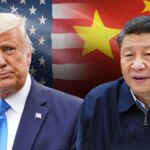
In a significant escalation of his ongoing trade dispute with China, President Donald Trump announced his intention to impose a sweeping 100% tariff on Chinese goods, effective November 1. This decision follows an earlier threat to cancel a scheduled meeting with Chinese President Xi Jinping, highlighting the increasing tensions between the two nations.
In a social media post, Trump expressed his concern over what he described as China’s “extraordinarily aggressive position on trade.” He noted that this policy shift was prompted by China’s announced plans to implement extensive export controls on a wide range of products, effective in late 2025. “It has just been learned that China has taken an extraordinarily aggressive position on Trade in sending an extremely hostile letter to the World,” Trump stated.
Additionally, Trump revealed that the U.S. would take further actions by imposing export controls on critical software, aiming to safeguard American technological interests. This announcement came shortly after he suggested tariffs earlier in the day, which triggered a significant sell-off in the stock market. The Dow Jones Industrial Average fell by 385 points, or approximately 0.8%, while the S&P 500 and Nasdaq experienced declines of 1.25% and 1.75%, respectively.
This friction between the U.S. and China intensified after China enacted new restrictions on rare-earth minerals—essential components in the production of semiconductors that are crucial for a variety of technologies, from artificial intelligence applications to household appliances. Trump criticized China for sending letters globally that threatened to impose export controls on all elements related to rare-earth production, asserting that such actions could make countries dependent on Chinese resources.
In his post, Trump emphasized his belief that “there is no way that China should be allowed to hold the World ‘captive,'” suggesting that this has been a long-standing strategy from Beijing. He acknowledged that his proposed tariffs might have painful implications for the U.S. economy but stressed the need to counteract what he views as an aggressive stance from China. Current tariffs on Chinese imports stand at 30%, a significant reduction from 145% earlier this year.
Trump’s comments also cast doubt on a planned meeting with Xi at the Asia-Pacific Economic Cooperation (APEC) summit in South Korea, stating, “There seems to be no reason to do so” in light of the escalating conflict. This announcement comes amidst a trade truce that is currently in place between the U.S. and China but is set to expire in the near future, leading to heightened uncertainty in global markets and international trade relations.