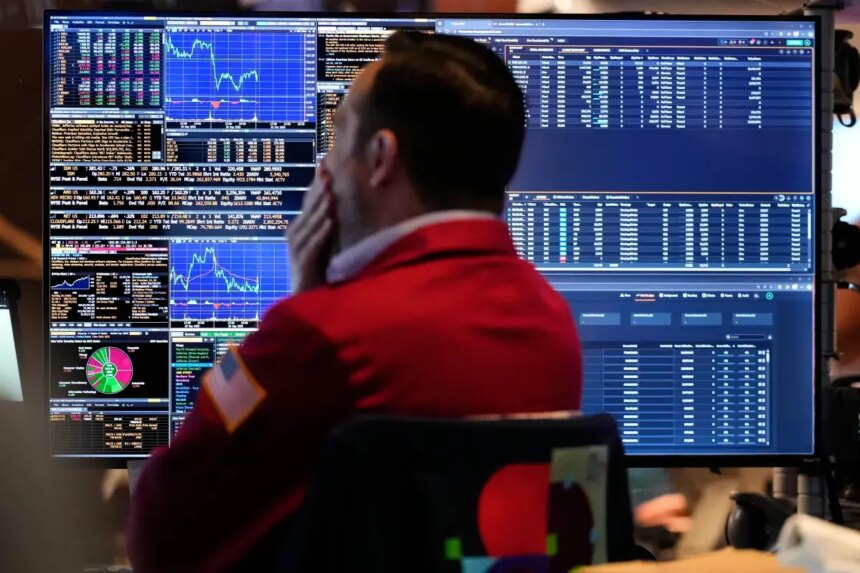
Record valuations in the U.S. stock market are stirring concerns about an imminent correction, echoing the dot-com crash of the late 1990s. Key indicators, such as the Shiller price-to-earnings (P/E) ratio, suggest that current levels may not align with earnings fundamentals. This ratio, a long-term measure of market valuation, has recently spiked above 40, far exceeding its historical average of approximately 17.3. According to financial experts, this sharp rise has occurred only three times since 1871, notably before significant downturns in late 1999 and early 2022.
The current environment is exacerbated by an influx of speculative investment in artificial intelligence, with hundreds of billions of dollars being funneled into the sector despite limited immediate returns. The market’s structure, heavily reliant on a few technology companies riding the AI wave, further amplifies fears of a fragile market poised for disruption. An unexpected shift in investor sentiment or a series of disappointing earnings reports could trigger a wider collapse, not just affecting domestic markets but potentially destabilizing the global financial system.
Additional market metrics, such as the “Buffett Indicator”—which compares the total market value of publicly traded stocks to the country’s gross domestic product—are also signaling overvaluation, prompting caution among investors. This indicator has recently shown levels that Warren Buffett himself has described as “playing with fire.”
John Turner, a finance professor at Queen’s University Belfast, has identified the combination of excessive money and credit, high marketability of assets, and rampant speculation as critical components of what he refers to as the “bubble triangle.” These elements are currently seen as being in place as investors pour funding into AI stocks, heightening the risk of a speculative bubble.
William Quinn, co-author of “Boom and Bust: A Global History of Financial Bubbles,” notes the parallels between present market enthusiasm for AI and historical technological bubbles seen in sectors such as railways, bicycles, and the internet. He points out striking narratives suggesting that AI has the potential to invalidate traditional valuation metrics, reinforcing the notion that the U.S. market may be exceptional and insulated from typical investment rules.
Despite recent trade policy developments spooking investors, the upward trajectory of the S&P 500 remains unbroken. Some analysts argue that fears of a bubble based on valuations may be overstated, and unlike the unsustainable businesses characterizing the dot-com era, AI holds transformative potential for various industries.
Entrepreneur and former presidential candidate Andrew Yang recently shared insights on the speculative nature of current valuations, emphasizing that much of the market’s value is based on future expectations rather than present revenues. He anticipates a significant market correction but remains optimistic about the transformative role of AI in multiple sectors.
Understanding the triggers for a market downturn poses a challenge. Economic experts, including David Rosenberg from Rosenberg Research, suggest that anything from a resurgence of inflation to companies missing earnings forecasts could act as catalysts for a correction. Historical crashes have often occurred with no obvious cause, indicating that market dynamics can be unpredictable.
Looking ahead, experts express uncertainty about the timing of a potential market correction. While indications suggest heightened risk, the exact moment a bubble might burst remains elusive. Warning signs such as rising interest rates or indications from government policy regarding market valuations can surface, but pricing in the market may continue to climb even in the face of such signals. The prevailing sentiment is that distinguishing between a speculative bubble and a sound investment environment will remain a formidable task, requiring careful monitoring by investors and analysts alike.