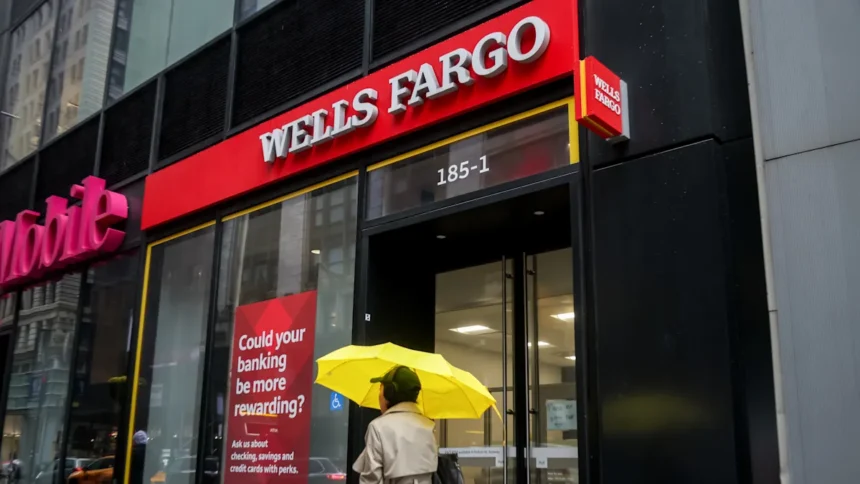
Shares of Wells Fargo & Co. surged significantly following the bank’s first major update on mid-term profitability targets since regulators lifted an asset cap on the institution. On Tuesday, the stock increased by 7.1%, marking its largest daily gain since November 6 of the previous year, a period that saw a rally in financial stocks after Donald Trump’s election.
This increase positioned Wells Fargo as the top performer in the KBW Bank Index for the day. Over the past month, the bank’s shares have only been outpaced by Comerica Inc., whose stock gained traction amid its planned acquisition by Fifth Third Bancorp—the largest banking deal of 2025.
Analysts noted that the bank’s performance was underpinned not just by better-than-expected earnings, but also by an assertive operational strategy. Scott Siefers, an analyst at Piper Sandler & Co., highlighted that Wells Fargo is “clearly front-footed” in its approach.
In a key development, Wells Fargo raised its return on tangible common equity (ROTCE) target to a range of 17% to 18%, up from its previous target of 15%. ROTCE serves as a vital metric for assessing a bank’s efficiency in generating earnings for shareholders, reflecting both growth pace and associated costs.
The bank’s total assets surpassed $2 trillion for the first time at the end of September. This milestone came on the heels of the Federal Reserve’s removal of a regulatory penalty in June that had previously prevented Wells Fargo from expanding beyond its end-of-2017 asset size of $1.95 trillion. Since being subjected to the asset cap, Wells Fargo’s shares had lagged behind those of its five largest bank peers.
In a recent interview, Chief Financial Officer Mike Santomassimo revealed that Wells Fargo intends to maintain its stock buyback program in the fourth quarter, aligning it with the substantial repurchase of $6.1 billion in common stock executed during the three months ending in September. This strategy is part of a broader effort to enhance shareholder value in the wake of regulatory changes and market conditions.