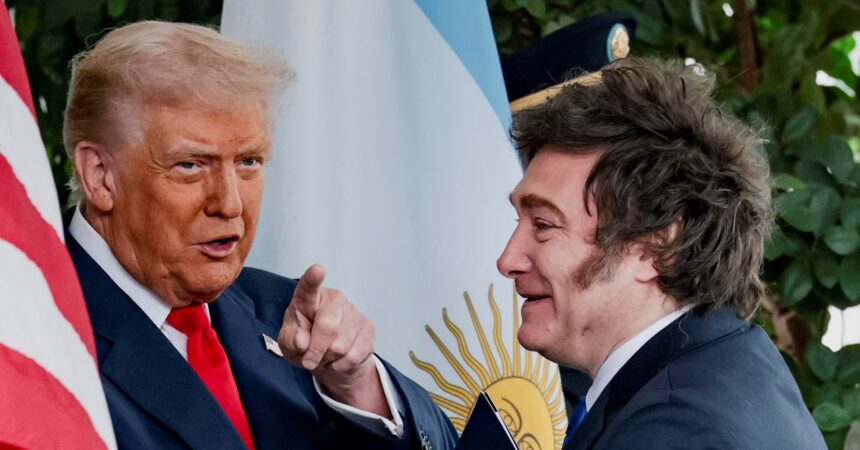
When U.S. President Donald Trump engaged in talks with Argentine President Javier Milei at the White House recently, he delivered a stark message regarding U.S. support for Argentina’s economy. Shortly after offering a $20 billion currency swap lifeline to the South American nation, Trump indicated that future assistance hinges on the success of Milei’s libertarian party in the upcoming midterm elections.
Milei’s economic policies, characterized by aggressive fiscal measures designed to combat rampant inflation, have garnered praise from the Trump administration and attracted investor interest. Despite achieving a fiscal surplus, the burden of austerity measures, including subsidy cuts and factory closures, has begun to unnerve segments of the Argentine populace. Concerns are growing about the sustainability of Milei’s approach, and Trump was clear in his assessment: “If he doesn’t win, we’re gone,” he told reporters.
The stakes are high as Argentina prepares for crucial midterm elections on October 26, wherein half of the lower Chamber of Deputies—127 seats—and a third of the Senate—24 seats—are up for grabs. The Peronist opposition currently commands the largest minority in both chambers, while Milei’s relatively nascent party, La Libertad Avanza, holds a modest representation with 37 deputies and six senators.
Political analysts highlighted that a performance exceeding 35% of the vote would signify a growing endorsement of Milei’s policies, especially when compared to the 30% garnered during the first round of the 2023 presidential election. If his party approaches 40%, it would be characterized as “a very good election,” according to Marcelo Garcia, director at the risk consultancy Horizon Engage.
A solid electoral performance would enhance Milei’s legislative power, facilitating his agenda for economic reform, which includes proposed labor reforms aimed at boosting workforce participation and new tax cuts yet to be detailed. Political stability for Milei hinges on his ability to maintain a commanding presence in Congress—a necessity, given recent instances where Congress overturned his vetoes on key funding bills.
For Milei to prevent opposition lawmakers from undermining his agenda, it’s imperative that his party secures approximately one-third of the votes in both chambers. This might necessitate alliances with centrist factions, including the PRO party, led by former President Mauricio Macri. However, the extent of support from potential allies is likely contingent on the election outcome.
Recent surveys indicate a drop in Milei’s approval rating, which has fallen below 40%, the lowest point of his presidency thus far. This decline is accompanied by rising concerns linked to his austerity measures and ongoing corruption allegations against individuals close to him. The scenario has been compounded by a judicial investigation related to leaked audio recordings implicating his sister and chief of staff, Karina Milei, in a bribery scheme, allegations Milei has vehemently dismissed as politically motivated attacks.
Additionally, a nominee from Milei’s party in Buenos Aires recently resigned over corruption claims, raising further challenges for the party’s credibility as the elections approach. Nonetheless, political consultant Facundo Cruz expressed optimism about the party’s national presence, suggesting that while its seat count is likely to increase, the extent of that growth remains uncertain.
With the midterm elections looming, the dynamics of Argentine politics and the future of Milei’s economic reforms hang in a precarious balance.