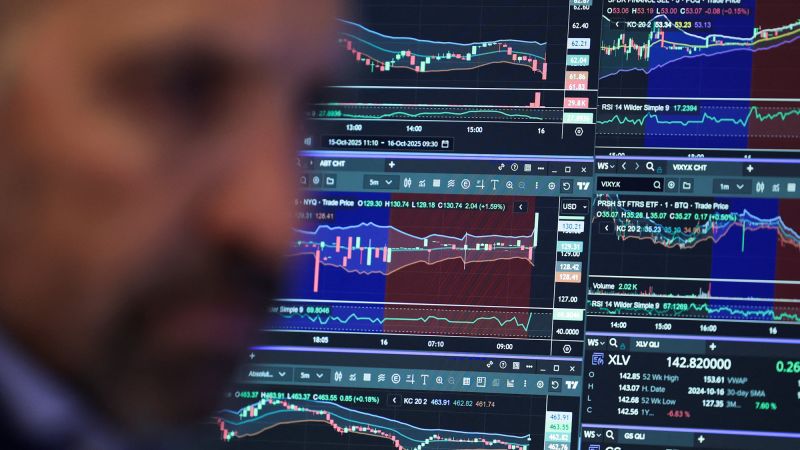
US stock markets experienced a downward shift on Thursday, driven by renewed anxiety over credit market instability and concerns surrounding regional banks’ exposure to questionable loans. The Dow Jones Industrial Average slid by 410 points, marking a 0.9% decline. Similarly, the S&P 500 also fell by 0.9%, while the tech-dominated Nasdaq Composite saw a 0.8% decrease.
The atmosphere on Wall Street has grown increasingly volatile, spurred by escalating US-China trade tensions, apprehensions regarding historically high stock valuations, and emerging issues within the banking sector. Regional bank shares were particularly hard hit, following disclosures from two lenders about their struggles with borrowers, thus intensifying fears over the credit environment and its potential repercussions on the stock market and broader economy.
Zions Bancorp saw a significant drop of 12% after announcing it would incur a $50 million loss in the upcoming third quarter due to a bad loan. Similarly, Western Alliance Bancorp’s stock plummeted by 10.5% after it revealed plans to litigate against a borrower, citing fraud allegations.
“Credit quality worries are plaguing Wall Street today as fears mount that there are multiple large lenders with heavy exposure to problematic loans with limited collateral,” stated José Torres, a senior economist at Interactive Brokers.
The anxiety surrounding credit markets has been exacerbated by the recent bankruptcies of auto lenders First Brands and Tricolor Holdings. Investors are increasingly apprehensive that major financial institutions may be burdened with loans that could potentially go unpaid.
Jefferies, a global investment firm, experienced a 10% decline in its stock price as it faces challenges linked to its connections with First Brands. Market strategist Michael Block expressed concern, suggesting that Jefferies could be a harbinger of broader issues, stating, “Everyone is waiting for a shoe to drop… It could be a false alarm or it could be that where there is smoke, there is fire.”
The growing uncertainty has pushed Wall Street’s fear gauge, the VIX, up by 20%, elevating it to levels not seen since May. With nearly 80% of S&P 500 companies trading in the red, the KBW Nasdaq Regional Bank index plummeted by 6.5%.
In response to the market turmoil, gold futures surged by 2.5%, surpassing $4,300 per troy ounce as investors flocked to safe-haven assets. Silver also demonstrated strength, gaining 3% and reaching record highs.
The bond market saw an influx of buyers, leading to lower yields. The yield on the 10-year Treasury note dipped below 4%, reaching its lowest since April, while the two-year yield fell to 3.42%, marking a new low since 2022.
During a recent earnings call, JPMorgan Chase CEO Jamie Dimon expressed apprehension regarding the credit market landscape, revealing that his bank has a $170 million exposure to Tricolor. “These are early signs there might be some excess out there,” he noted, cautioning that a downturn could yield more significant credit issues. Dimon further emphasized the potential risk posed by elevated asset prices and low credit spreads, stating, “I’d feel more comfortable if that weren’t true because that’s a long way to fall.”
“The market kind of thinks everything’s going to be fine, and you know, I’m not quite so sure of that,” he concluded during his remarks at the annual Institute for International Finance meeting.