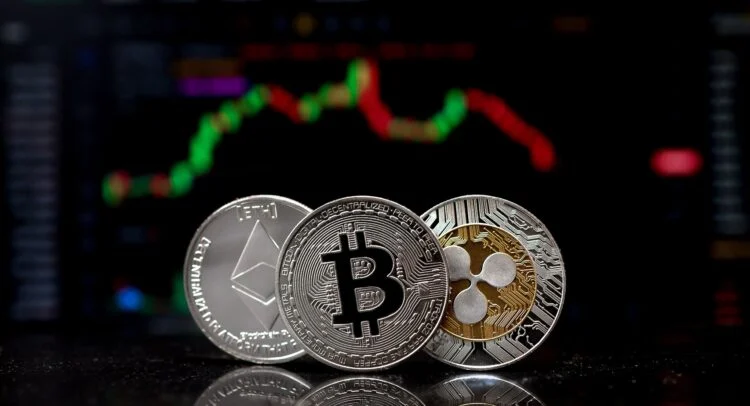
The interplay between Bitcoin and the broader cryptocurrency market is crucial, as Bitcoin’s dominance has traditionally set the tone for market trends. A significant drop in Bitcoin’s value could not only impact its own price but also have cascading effects on major altcoins like Ethereum (ETH) and XRP, raising questions about the level of independence these assets truly possess from Bitcoin’s influence.
Historically, Bitcoin has operated as the cornerstone of the crypto market, with its price movements closely correlating to those of other digital assets. This phenomenon became evident after the market shock on October 10 when the correlation between Bitcoin and Ethereum rose to an impressive 0.73, while Bitcoin’s correlation with XRP reached 0.77. These numbers highlight a strong statistical association, suggesting that when Bitcoin experiences a downturn, it drags down the rest of the market with it—a scenario that can be metaphorically summarized: when Bitcoin sneezes, the rest catch a cold.
This market interconnectedness stems from Bitcoin’s role as the “anchor asset,” intricately shaping market sentiment, liquidity, and trading structures across exchanges. A decline in Bitcoin often triggers a series of margin calls, tightens liquidity, and prompts investors to retreat to safer assets. As a result, even fundamentally robust tokens, such as Ethereum and XRP, may see their values depreciate, not due to their inherent utility, but rather due to the overarching trend of the market acting as a unified risk basket.
In hypothetical scenarios where Bitcoin plummets significantly—say by 50%—the responses from Ethereum and XRP could differ but are likely to be steep. Historical data suggests that Ethereum, with a beta often exceeding 1.0 in relation to Bitcoin, could face an even more drastic decline. While its robust staking and application ecosystem might facilitate a quicker rebound, the initial shock is likely to hit hard.
XRP, meanwhile, faces unique challenges due to its heightened regulatory risks and relatively lower organic yield compared to Ether. Its price movements are often dictated by broader market sentiment rather than its utility during times of distress. Historically, events like the FTX collapse and Terra’s failure have illustrated that Bitcoin-led selloffs tend to erase distinctions among various crypto projects, leading to widespread declines across the board.
For investors, understanding and mitigating the risks associated with Bitcoin’s volatility is essential for portfolio protection. The common strategy of diversification within crypto assets tends to falter when markets face stress, as correlations spike during such times. As a result, investing in structural hedges is advisable rather than merely holding multiple coins.
Utilizing derivatives—such as futures or perpetual contracts—can be an effective technique to hedge exposure or capitalize on price volatility during periods of panic. Additionally, maintaining a portion of the portfolio in stablecoins or even tokenized gold can provide a reserve of liquidity and safety when the market sentiment shifts to risk-off.
Monitoring the short-term correlations among Bitcoin, Ethereum, and XRP can also serve as a critical early warning system for potential market contagion. A tightening of these links could indicate that a widespread selloff is imminent. Lastly, investing in yield-generating assets like staking or lending pools may help mitigate losses and provide steady returns, aiding investors as they navigate through market recoveries.
For real-time updates and insights on their preferred cryptocurrencies, investors can leverage platforms like the TipRanks Cryptocurrency Center.