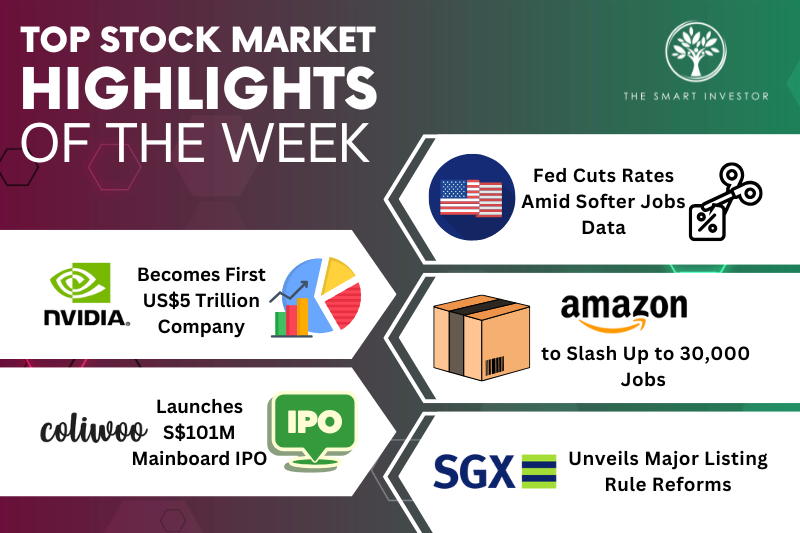
This week witnessed significant developments in the financial world, marked by notable policy decisions and corporate achievements that are shaping market dynamics.
On October 29, the Federal Reserve made a pivotal decision, cutting interest rates by 0.25 percentage points. This adjustment brings the federal funds rate down to a range between 3.75% and 4%. The Fed’s move reflects growing concerns surrounding elevated unemployment and an uncertain economic forecast. While inflation remains a concern, the central bank indicated that risks to employment have increased, prompting a reconsideration of its monetary policy approach. Additionally, the Fed announced plans to conclude its program of reducing securities holdings by December 1, 2025, indicating a shift in its strategy as it navigates conflicting economic pressures.
In a landmark event for the tech industry, Nvidia made history by becoming the first publicly traded company to reach a market capitalisation of US$5 trillion. The milestone was achieved on October 29, with Nvidia’s stock rising over 5% to close at US$207.04. The surge is attributed to the ongoing momentum in artificial intelligence, as well as speculation about future chip sales to China. CEO Jensen Huang’s forecast of US$500 billion in AI chip sales, alongside plans for seven new supercomputers for the U.S. government, has further buoyed investor sentiment. Notably, this achievement comes just three months after Nvidia crossed the US$4 trillion mark and represents a nearly 50% increase in the stock’s value year-to-date. The company also announced significant investments, including a US$1 billion stake in Nokia and partnerships with leading technology firms.
Amid these corporate milestones, Amazon announced substantial workforce reductions, cutting 14,000 corporate positions on October 28 — its largest layoffs in recent years. The decision is reflective of the e-commerce giant’s strategy to become “leaner and less bureaucratic” as it shifts focus towards artificial intelligence initiatives. CEO Andy Jassy detailed that this restructuring will involve several divisions including cloud computing and advertising. Employees impacted by the layoffs will have 90 days to explore internal job opportunities before receiving severance packages. Reports indicate that the total number of cuts could rise to 30,000 positions, representing about 4% of Amazon’s corporate workforce of 350,000. These layoffs coincide with the company’s planned US$118 billion capital investments for the year, primarily directed towards AI and cloud infrastructure enhancements.
In Singapore, the co-living operator Coliwoo Holdings made its initial public offering on October 29, offering 80.3 million shares priced at S$0.60 each, aiming to raise approximately S$101 million. With major cornerstone investors committing S$52.8 million, Coliwoo’s mainboard listing is set to commence trading on November 6, 2025. The company, which operates nearly 3,000 co-living rooms, has plans to expand to 4,000 by the end of 2026. Post-IPO, its market capitalisation is expected to reach S$288.5 million, with intentions to distribute at least 40% of attributable profits as dividends over the next two fiscal years.
Lastly, Singapore Exchange Regulation (SGX RegCo) announced comprehensive reforms on October 29 aimed at transitioning to a disclosure-based regulatory regime. Key changes include lowering the profit test threshold for mainboard listings from S$30 million to S$10 million, eliminating the Financial Watch-List, and consolidating listing review processes under SGX RegCo. The regulator also plans to introduce tailored admission requirements for pre-revenue life sciences companies while limiting trading suspensions to critical cases. Additionally, the Monetary Authority of Singapore suggested streamlining the IPO process, allowing potential issuers to interact solely with SGX RegCo for greater efficiency. These reforms are designed to enhance Singapore’s competitiveness as a global capital market hub while ensuring investor protection.
As the week unfolds, investors remain on the lookout for further developments that could influence market trends and investment strategies.