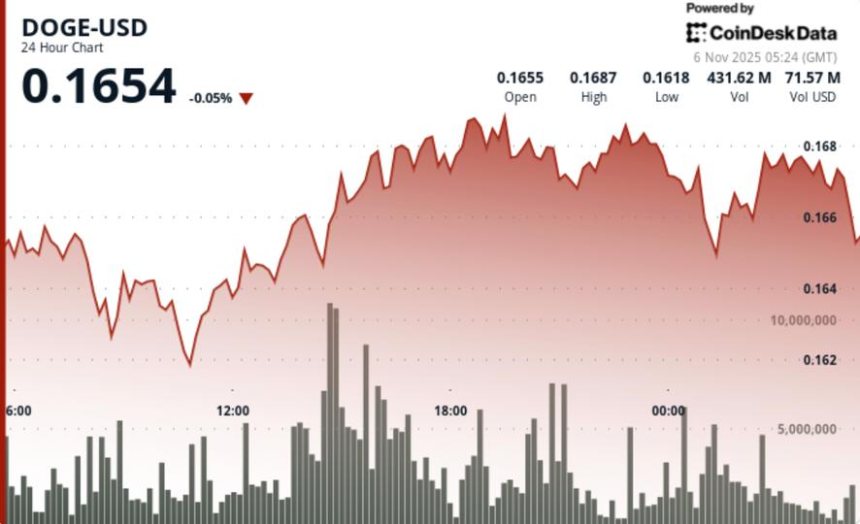
In the latest trading session, Dogecoin experienced a modest decline of 0.5%, settling at $0.1657. This drop occurred as institutional trading efforts rotated near a significant resistance level, despite a notable volume increase of 104% above daily averages. The cryptocurrency managed to uphold its ascending channel structure, illustrating a short-term bias that remains neutral-to-bullish as it defends the critical support level just above $0.16.
Institutional positioning has been instrumental in shaping Dogecoin’s intraday dynamics. Following initial accumulation around $0.1620 at the beginning of the week, large-cap holders began to reduce their positions when buying interest waned near the $0.1670 mark. A breakout attempt on Tuesday, which saw a trading volume of 774 million, highlighted that the price movement was largely influenced by institutional investors rather than retail speculation.
Despite a lackluster sentiment across the broader meme-coin landscape, there has been a slight increase in derivative open interest for Dogecoin futures on platforms such as Binance and Bybit. This influx suggests that traders are engaging in speculative hedging rather than taking on new risk. Analysts have noted that Dogecoin’s ability to remain above the $0.16 threshold indicates that profit rotation is occurring in a disciplined manner rather than showing signs of trend fatigue.
Examining the price movements, Dogecoin initially rose from $0.1646 to reach $0.1665 before retracting slightly to $0.1657. Notably, support levels have held firm at $0.1617–$0.1620 across four consecutive hourly evaluations. Trading volumes peaked at $0.1665 with 8.9 million during a brief window, indicating institutional selling pressure at those highs. The existing channel structure remains positive, suggesting that higher lows could set the stage for future breakout attempts above the $0.16 level.
From a technical perspective, the trend for Dogecoin is currently characterized as sideways-to-bullish within its ascending channel. The primary support level resides at $0.1620, with a secondary buffer at $0.1617. Resistance remains robust in the $0.1665–$0.1670 area, which has shown repeated rejections at high volumes. The volume of 774 million confirms significant institutional engagement, while volatility stands at 4.2%, indicating a compression phase that could precede the next significant directional movement.
Traders are closely monitoring key indicators, including the bulls’ ability to maintain the $0.1620 support level amid declining volumes, which is essential for the integrity of the current structure. A successful breakout above $0.1670 could signal a potential upward movement towards $0.17–$0.175. Conversely, any intraday trading below $0.1615 may signify a structural failure, potentially leading to further downside expansion. Additionally, cross-asset flow from Bitcoin or Solana will serve as crucial market indicators for gauging overall risk appetite.