Recent analysis conducted by a seasoned investor with over 60,000 hours of trading experience and a degree in Economics from Harvard underscores the current valuation trends within U.S. equities. Dan Buckley from DayTrading.com provides a comprehensive evaluation of market dynamics, particularly focusing on the forward Price-to-Earnings (P/E) ratio, which serves as a critical metric for assessing investor sentiment regarding future profitability.
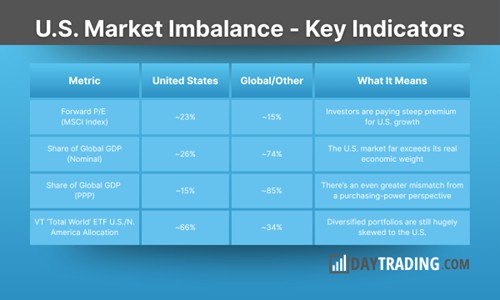
Buckley highlights that U.S. equities are currently trading at approximately 23 times their predicted earnings for the next year. In stark contrast, international markets are being valued at around 15 times, creating a significant discrepancy of approximately 51%. “When valuations stretch this far, future returns tend to be modest at best and can even be negative,” he warns, drawing attention to the historical context behind such elevated valuations.
The review also examines the U.S. stock market’s performance since its peak in 2021, revealing a compound annual return of about 9%. However, Buckley points out that prior to this uptick, the market faced nearly a decade of stagnant growth, with U.S. equities taking nearly two years to recover to pre-downturn levels following the setbacks of early 2022.
Further digging into the data, Buckley’s analysis unveils a notable imbalance: despite the U.S. accounting for only around 26% of the world’s economic output in nominal terms—and even closer to 15% when adjusted for cost of living—American assets command about 65% of the MSCI All Country World Index. This imbalance suggests a significant overrepresentation of U.S. equities in global investment portfolios, reflecting a strong preference among international investors for U.S. markets.
Even diversified investment vehicles, such as the Vanguard Total World Stock ETF, exhibit this skew, allocating roughly 66% of their investments within the U.S., including a striking 4% in the single company Nvidia. Buckley illustrates the problem of overconcentration in portfolios, stating, “When one single chipmaker accounts for more in a portfolio than many entire countries, diversification is merely a slogan—not a reality.”
The analysis also sheds light on the impact of artificial intelligence on market performance. About half of the gains in the S&P 500 for 2025 have been attributed to companies associated with AI, particularly semiconductor firms and tech giants like Nvidia, Microsoft, Advanced Micro Devices, and Palantir. While Buckley acknowledges the transformative potential of AI across various sectors, he cautions that not every firm will succeed simultaneously, drawing parallels to the dot-com era when many companies faltered while only a select few prospered.
In closing, Buckley stresses that his observations are not necessarily indicative of an impending market downturn. Instead, they serve as a cautionary note, highlighting areas of potential imbalance that may arise under inflated market expectations. Some sectors—including financials, healthcare, select industrials, and international markets—still portray valuations reflective of their fundamental strengths. Buckley emphasizes that even minor signs of strain can trigger adjustments in a market that may already be priced for perfection, suggesting that prudence is warranted for investors navigating the current landscape.