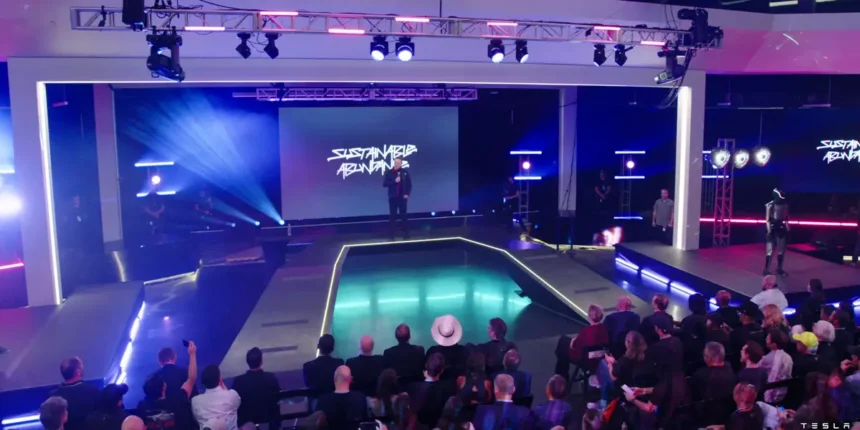
Tesla’s shareholders made a significant decision concerning CEO Elon Musk’s future at the company, approving a hefty pay package that could reach $1 trillion, conditional on achieving certain performance benchmarks over the next decade. The vote took place on Thursday, with 75% of shareholders backing the proposal. Musk expressed confidence in the company’s trajectory, stating, “What we’re about to embark upon is not merely a new chapter of the future of Tesla, but a whole new book,” during a celebratory event that featured an Optimus robot performing on stage.
Following the announcement, Tesla’s stock saw a 2% increase in after-hours trading. The company shared its appreciation on social media, posting, “We love y’all.”
The reaction to the vote among analysts and investors was mixed, with supporters and opponents vocalizing their perspectives. Bullish analysts rejoiced at the outcome, viewing it as a positive indication of Musk’s ongoing leadership role. Dan Ives, an analyst at Wedbush, characterized Musk as a “wartime CEO” poised to navigate Tesla through an upcoming AI revolution. He noted that while the pay package approval was a win, achieving its associated metrics would be challenging. To unlock the full value of the package, Tesla must meet ambitious goals such as delivering 20 million vehicles and achieving 10 million active full self-driving subscriptions, along with producing 1 million Optimus robots and getting 1 million robotaxis operational.
Gene Munster, a seasoned analyst and managing partner at Deepwater Asset Management, described the vote as a dual victory for Tesla investors. He emphasized that it grants Musk the authority and motivation to remain actively engaged in the company, which could help stabilize the stock during difficult financial periods.
However, the approval was not without controversy. Some investors and an electric vehicle watchdog organization expressed concern, criticizing the decision as a reflection of poor corporate governance and a lack of accountability. The SOC Investment Group, a consortium of investors, urged shareholders to vote against the pay plan. They voiced their “deep concerns” regarding Musk’s dominant role within the company, suggesting that the measures taken for the vote—including paid social media campaigns and hiring consultants—were excessive and indicative of a governance issue.
New York State Comptroller Thomas DiNapoli, representing the New York State Common Retirement Fund, echoed these sentiments, labeling the decision as “pay for unchecked power, not pay for performance.” He argued that the board’s actions have entrenched Musk in a position where he answers to no one, thereby undermining accountability.
In a broader context, the industry watchdog Safe Autonomous Vehicles Everywhere voiced alarm over the implications of the pay package. Their national campaign director, Shua Sanchez, highlighted concerns that the new financial incentives might push for hastily deployed autonomous technology before it can be proven safe for public use. Sanchez insisted that the plan fails to prioritize safety, an essential component in the deployment of transformative automotive technologies.
As Tesla navigates this contentious watershed moment, the implications of this decision may resonate not only within the company but also across the broader automotive and tech sectors, where governance, innovation, and accountability are of paramount importance.