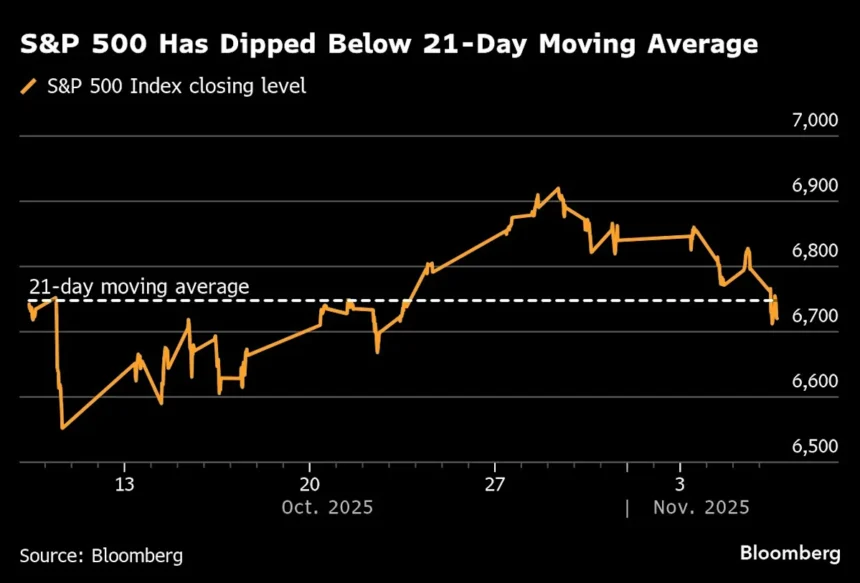
Traders are closely analyzing technical charts as they navigate a turbulent phase in the U.S. equity market. Recently, skepticism surrounding substantial investments in artificial intelligence has emerged, causing the S&P 500 Index to plummet to 6,720.32 on Thursday—the lowest point in two weeks. Analysts are spotlighting the 50-day moving average of 6,665 as a pivotal threshold that could signal further declines.
Technical analyst Tyler Richey emphasizes that a drop below this level could indicate “technical cracks emerging” in the market. Conversely, if the index recovers to its 21-day moving average of 6,748.10, it might reinvigorate a risk-on sentiment among investors. While technical patterns are not the sole focus for investors, they provide valuable insights into possible market inflection points, especially in light of the lack of government data releases due to a shutdown, a peak earnings season now behind us, and ongoing uncertainties surrounding Federal Reserve policies.
The S&P 500 has seen its third decline of at least 0.99% within the past six sessions, marking a 2.5% drop from its last record. The volatility in the market is reflected in the Cboe Volatility Index, which has surged towards 20. Richey characterizes the current skid as a “critical tipping point.”
Investor fears intensified after Challenger, Gray & Christmas Inc. reported that October saw the highest job cut announcements in over two decades, spurred by cost-cutting initiatives related to AI. Additionally, concerns over elevated valuations in technology stocks have added to the market’s fragility. The Bloomberg Magnificent Seven Price Return Index experienced a 2% drop on Thursday, marking its third similar decline in just six sessions.
Before the focus shifts to the 50-day moving average, observers are watching the critical round-number barrier at 6,700. Brent Kochuba of SpotGamma notes that there is significant open interest in S&P 500 contracts at this strike, suggesting that this may provide temporary support as traders seek insurance against market downturns.
Strategists at JPMorgan Chase & Co. have identified the 6,740 to 6,800 range as a key technical level for the S&P 500. They caution that a breach below the 6,640 mark would indicate a more severe bearish signal. Meanwhile, Maxwell Grinacoff, leading U.S. equity derivatives research at UBS, reports a noticeable uptick in hedging activity over the past month. He highlights that the VIX has remained close to the critical 20 level since mid-October.
As earnings season comes to a close and investors find themselves relying on private data due to the ongoing economic data drought, attention will soon turn to Nvidia Corp.’s earnings, set for November 19, which may serve as a significant market catalyst. Grinacoff concludes that “risks abound” and that investors are keenly aware of the increasing fragility of the market.