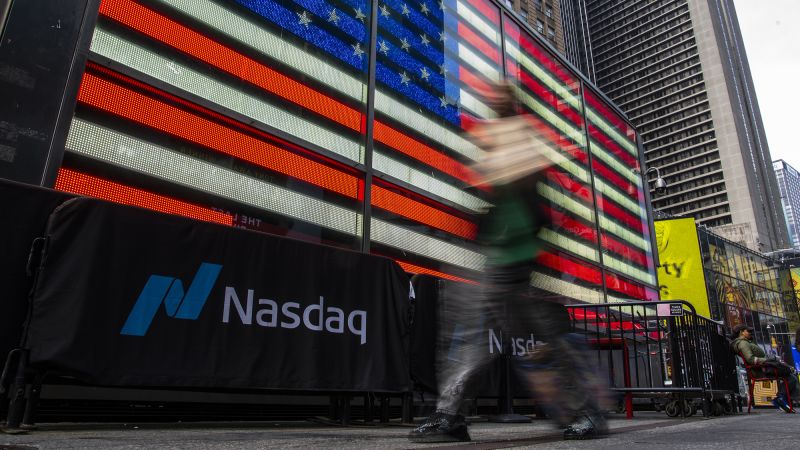
Tech stocks faced significant challenges this week, as uncertainty about a potential artificial intelligence (AI) bubble weighs on investor sentiment. The Nasdaq Composite, known for its tech-heavy listings, dropped 1.6% on Friday, marking a trajectory for its poorest weekly performance since early April. During that time, market turbulence was triggered by President Donald Trump’s announcement regarding reciprocal tariffs, a reminder of how swiftly conditions can shift.
In broader market reflections, the benchmark S&P 500 declined by 1%, while the Dow Jones Industrial Average fell by 300 points, or 0.65%. This sell-off in tech stocks is overshadowing the market overall, creating ripples of concern.
Wall Street’s apprehensions are underscored by the CBOE Volatility Index, which surged 16%, indicating heightened fear among investors. The Fear and Greed Index from CNN recorded a dip into “extreme fear,” landing at its lowest point since last spring, further emphasizing the prevailing anxiety.
This week’s downturn has been significantly influenced by comments from high-profile CEOs at Goldman Sachs and Morgan Stanley, both cautioning against soaring valuations within the tech sector. Their concerns highlight a critical pivot in market expectations, as the bar for positive earnings surprises continues to escalate following a substantial market rally in recent months.
Scott Wren, a senior global equity strategist at Wells Fargo Investment Institute, noted that “concerns percolating under the surface with AI valuations” are creating additional layers of complexity for investors. While AI and tech stocks have been major drivers of the recent bull market, rising share prices suggest that these assets may be increasingly overvalued, leading to skepticism about whether the vast investments in AI infrastructure can be justified.
Individual stock performances reflect these sentiments. Nvidia shares fell by 3% on Friday and were trending toward their worst weekly decline since April; similarly, Palantir shares dropped 1.6%, also on track for substantial losses this week. Perhaps most strikingly, Oracle, which experienced a meteoric rise of 36% in a single day last month following a deal with OpenAI, has nearly erased those gains, with its shares plummeting 11% this week—marking its worst performance in seven years.
Adding to market jitters, OpenAI, a leading player in the AI sector, encountered backlash after its executives backed away from earlier statements suggesting that government assistance may be required to fund approximately $1.4 trillion in anticipated chip and infrastructure costs.
Market strategist Mike O’Rourke from JonesTrading remarked on the extensive uncertainty that major technology companies face, stating that many have become intertwined with organizations that lack the financial capacity to meet their obligations. This interconnectedness is fostering a greater degree of unpredictability in financial forecasts.
On Friday, the S&P 500 fell below its 50-day moving average—an important technical indicator—and has seen a decline of roughly 2.7% this week. Beyond tech concerns, the impacts of a prolonged U.S. government shutdown loom large, with analysts like David Russell from TradeStation warning that the longer it persists, the more pronounced its effects will be on the general populace.
Consumer sentiment has also suffered, hitting its lowest level since June 2022, as indicated by the latest survey from the University of Michigan. Many respondents voiced concerns regarding the economic outlook and their personal finances, with numerous comments linking their sentiment to the ongoing government shutdown.
Despite the current volatility, some experts believe that a pullback in the S&P 500 could present buying opportunities for long-term investors, as noted by Wren at Wells Fargo Investment Institute. The evolving landscape remains under close scrutiny as market participants navigate the complexities of both the tech sector and broader economic conditions.