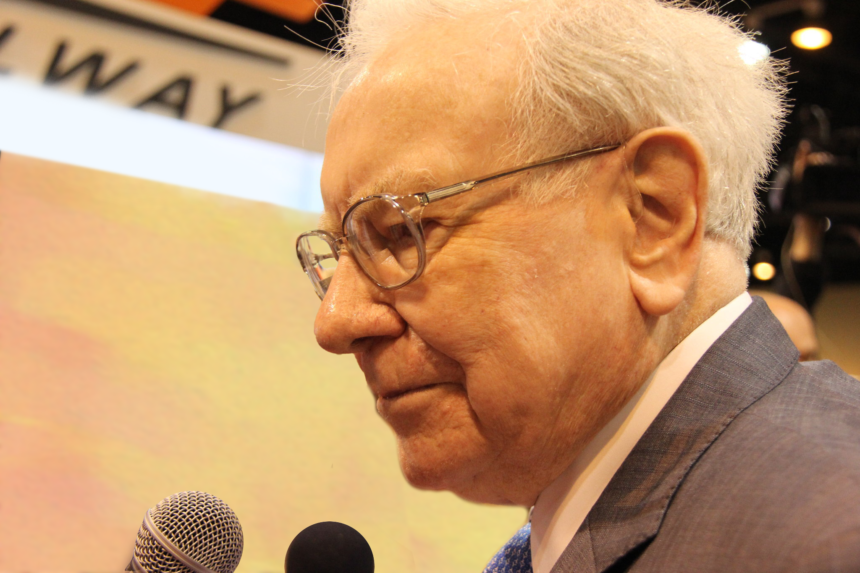
Investors are bracing for a turbulent market as legendary investor Warren Buffett sounds alarm bells regarding stock valuations. With Berkshire Hathaway amassing its largest cash reserves ever and Buffett adopting a net selling strategy for the past three years, there are clear indications that the “Oracle of Omaha” believes the current state of the stock market is concerning.
Buffett’s apprehensions were notably articulated in a 2001 Fortune article where he presented a chart detailing the ratio of total stock market capitalization to gross national product (GNP). Declaring this ratio as “probably the best single measure of where valuations stand at any given moment,” he warned that a peak in this measure—previously reaching all-time highs—was a harbinger of impending market downturns. At that time, Buffett cautioned that if the ratio approached 200%, investors would be “playing with fire.” Today, the ratio has soared to approximately 223%, casting a shadow over the current market landscape.
However, despite Buffett’s stark warnings, many investors are adopting a mindset characterized by the dangerously optimistic refrain: “This time it’s different.” The S&P 500 index is nearing its all-time high, and confidence seems to have taken precedence over caution.
The context for current market conditions has evolved significantly since the early 2000s, and some argue that there is a case to be made for the notion that things are indeed different this time around. One key change lies in the transition from GNP to gross domestic product (GDP) as the preferred economic measure. GDP offers a broader perspective, incorporating the total value of goods and services produced domestically, regardless of the producer’s nationality.
Additionally, advancements in artificial intelligence could be compelling investors to reconsider traditional valuation metrics. The early stages of innovations in AI have spurred discussions about potential efficiency gains and profitability enhancements for companies, potentially transforming business landscapes. As firms work towards developing artificial general intelligence (AGI) and superintelligence (ASI), the full economic ramifications of these technologies remain largely unforeseen.
Buffett himself has acknowledged in the past that the stock market capitalization to GNP ratio has its limitations, primarily function as a snapshot rather than a predictive tool. If AI ultimately leads to substantial increases in corporate profits, the current high reading of the Buffett indicator might not correctly portray the market’s true value.
Nevertheless, while the potential of AI to reshape industries is intriguing, dismissing Buffett’s time-tested insights could be unwise. The consequences of betting against the “Oracle of Omaha” in tumultuous times could be significant, as history suggests that his caution is often rooted in sound fundamentals. Investors must weigh the prospects of transformative technologies against the lessons of the past, especially as the stock market straddles a precarious balance between optimism and caution.