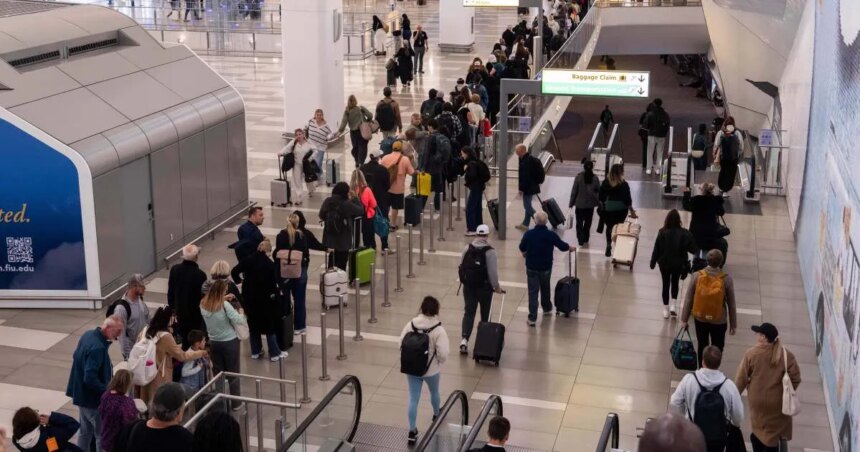
US senators have reached a stopgap deal aimed at ending the ongoing government shutdown, invigorating hopes to resolve a deadlock that has persisted for over six weeks. This development comes as airlines across the nation reported significant disruptions, canceling more than 3,300 flights amid dire warnings from transportation officials regarding the potential for air travel to “slow to a trickle.”
As the impasse entered its 40th day, the increasing alertness surrounding travel disruptions became palpable when the Federal Aviation Administration (FAA) implemented air traffic reductions due to concerns over air traffic controllers’ fatigue. Many controllers, classified as “essential” employees under U.S. regulations, have continued to work without pay since the shutdown commenced on October 1.
On a particularly disruptive Sunday, 3,304 flights were canceled, with an additional 10,000 flights experiencing delays, according to the flight-tracking website FlightAware. This followed a grim trend: approximately 1,500 cancellations the day before, alongside around 1,000 the previous Friday. The FAA’s strategy involves phased reductions in air traffic, mandating a 4 percent decrease in domestic flights starting Friday morning, with further planned reductions of 6 percent on Monday, 8 percent by Thursday, and culminating with a 10 percent reduction by the next Friday.
US Secretary of Transportation Sean Duffy underscored the urgency of the situation in various media remarks, highlighting that air travel could face severe limitations as Thanksgiving approaches on November 27. “As we get closer to Thanksgiving travel, I think what’s going to happen is you’re going to have air travel slow to a trickle, as everyone wants to travel to see their families,” Duffy stated while warning that conditions are projected to worsen until air traffic controllers receive their wages.
The Thanksgiving holiday is traditionally one of the busiest travel periods in the United States, with around 80 million Americans expected to travel. The Sunday following last year’s Thanksgiving saw airports screening a record 3.09 million passengers.
Amid mounting fears of travel chaos, lawmakers announced a compromise to restore government funding through the end of January. The Senate has initiated a procedural vote on the funding package, buoyed by moderate Democrats signaling support alongside Republicans. However, the plan still hinges on approval from both the Senate and the US House of Representatives, followed by the signature of President Donald Trump.
While the end of the shutdown may be in sight, uncertainty looms regarding potential lingering travel disruptions. The FAA has indicated that the decision to lift flight reductions will be contingent upon safety data. Industry analysts, including Richard Aboulafia of AeroDynamic Advisory, expressed skepticism about the FAA’s restrictions, suggesting they may be an “arbitrary” measure designed to exert political pressure to conclude the shutdown. Aboulafia noted that while the rationale for restricting capacity could be valid if supported by data, the lack of transparency regarding the data raises concerns among stakeholders.