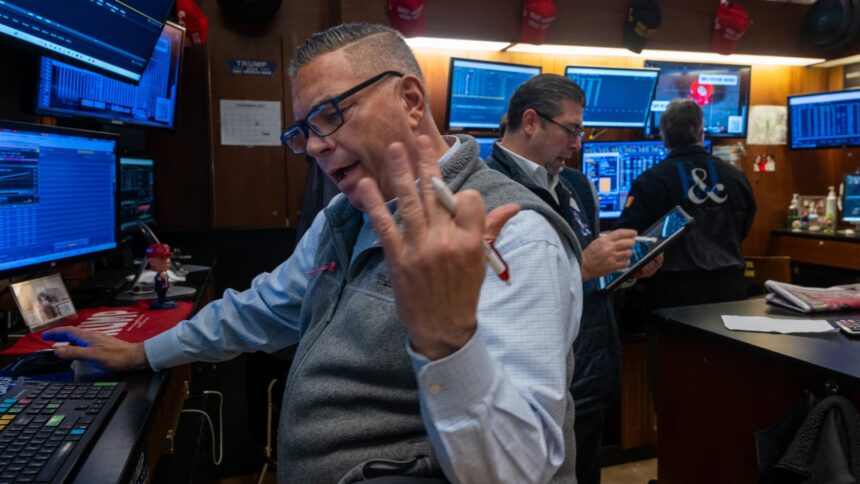
Traders on the floor of the New York Stock Exchange witnessed significant market movements on Wednesday as the Dow Jones Industrial Average reached its second consecutive record high, closing above the 48,000 mark for the first time. This milestone underscores a growing divide in the U.S. stock market, which appears to be bifurcating into two distinct segments: one that embraces artificial intelligence and technology, and another that encompasses traditional sectors.
The Dow, composed of 30 blue-chip companies, typically serves as an indicator of the “old economy.” The index’s rise on Wednesday was bolstered by key players such as Goldman Sachs, Eli Lilly, and Caterpillar, among others. Although technology firms like Nvidia and Salesforce are included in the Dow, the index’s price-weighted nature means that their influence is somewhat muted compared to older, more established companies.
In stark contrast, the Nasdaq Composite, heavily weighted toward technology stocks, experienced a decline. The drop was attributed to poor performances from firms including Oracle and Palantir, despite Advanced Micro Devices’ jump of 9% driven by optimistic growth projections. This divergence does not necessarily signal a looming crisis in the AI sector; instead, analysts believe it reflects a natural market correction rather than a catastrophic bubble. “There’s nothing wrong, in our view, of kind of trimming back, taking some gains and re-diversifying across other spots in the equity markets,” noted Josh Chastant, a portfolio manager at GuideStone Fund.
Investors are hopeful that the two distinct paths of the markets will converge, which would typically signal a more stable and unified growth trajectory.
In other market developments, the S&P 500 remained largely unchanged, while the pan-European Stoxx 600 gained 0.71%, showing broader international optimism.
In a notable push towards advancing America’s AI infrastructure, Anthropic announced plans to invest $50 billion, with the first custom data centers to be located in Texas and New York. These facilities, in collaboration with Fluidstack, are slated to commence operations in 2026, marking a significant expansion in the AI cloud space.
However, the release of critical October jobs and inflation data may face delays due to the government shutdown, raising concerns about the government’s data collection capabilities. White House press secretary Karoline Leavitt indicated that the fallout from the shutdown may have long-lasting effects, though analysts remain skeptical about the extent of this impact.
On the legislative front, the House of Representatives has cleared a procedural hurdle necessary to vote on a bill aimed at ending the government shutdown, with votes expected to occur shortly.
Amid these developments, the investment climate remains mixed. U.K.-based Blue Whale Capital’s CIO, Stephen Yiu, highlighted the potential of certain U.S. mining stocks, suggesting that factors like the fiscal deficit and dollar weakness could contribute positively to their performance.
Meanwhile, private equity firms are grappling with an emerging challenge: the proliferation of “zombie companies.” These entities, which neither flourish nor fail, exist in a limbo where they generate just enough cash to service their debts but struggle to attract buyers. As a result, they are stuck on portfolios well beyond their anticipated holding period, presenting a unique challenge for investors navigating today’s complex market landscape.