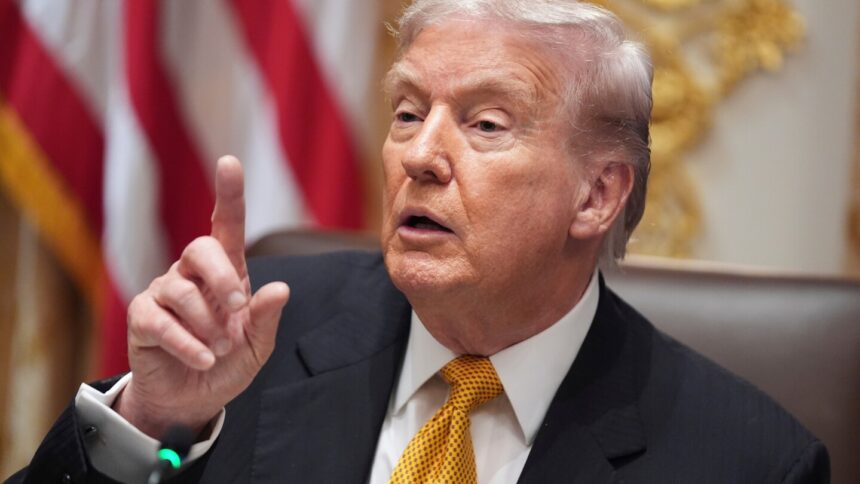
President Donald Trump has once again stirred discussion with a series of ambitious proposals, some of which are gaining traction while others seem to fade away. His tendency to push unconventional ideas has led to a mixture of reactions, from enthusiasm to skepticism.
One of his latest propositions includes the introduction of 50-year mortgages. Trump shared a post on his social media platform juxtaposing images of himself and historical figures, highlighting the long-term mortgage concept. Supporters, including Bill Pulte, director of the Federal Housing Finance Agency, praised longer loan terms as potentially transformative for housing affordability. However, economists expressed concerns, stating that while this could lower monthly payments, it would delay mortgage holders from building equity. Despite initial pushback, White House press secretary Karoline Leavitt confirmed that Trump’s economic team is actively considering this idea.
Another proposal involves the distribution of tariff revenue checks, where Trump claimed that tariffs could lead to a “dividend of at least $2000” for Americans. Critics quickly dismissed this notion, noting that consumers already bear the brunt of high import levies. Treasury Secretary Scott Bessent has also indicated that the feasibility of such checks was uncertain, despite the White House’s assurances that they are committed to making this reality possible.
Trump’s suggestion to issue $10,000 bonuses for air traffic controllers who worked without pay during the government shutdown remains unfulfilled. When pressed on funding for this initiative during an interview, he admitted he wasn’t sure how it would be financed, underscoring the uncertainty surrounding some of his financial promises.
The push for reinstating the death penalty in Washington, D.C., has largely diminished. Trump had issued a directive to enforce such laws, but the D.C. City Council repealed capital punishment in 1981, and attempts to reintroduce it have met with public disapproval in past referendums. Given the complexity of jurisdiction, many crimes in the district do not fall under federal law.
In February, Trump signed an executive order to explore the creation of a sovereign wealth fund for the U.S., akin to those in oil-rich nations. However, the country operates with significant budget deficits, complicating the establishment of such a fund. In the interim, the administration has been strategically investing in firms tied to national security without enacting a formal fund.
Trump has also voiced his disdain for recent NFL kickoff rule changes, which were designed to reduce injuries. He expressed his belief that these alterations detract from the game’s traditional appeal, although he acknowledged the NFL’s autonomy in implementing rules.
Another intriguing notion is Trump’s desire to have the Washington Commanders’ new stadium named after him. The idea has not received the team’s endorsement, and Trump has called for a return to the team’s previous name, “Redskins.” He even floated the possibility of blocking stadium construction unless the name was changed, although specifics on such measures remain unclear.
Discussions about suspending habeas corpus for expedited deportations, initiated by White House officials, have dissipated, with Trump exhibiting a lack of knowledge on the topic in a recent event.
Moreover, Trump hinted at retrieving Bagram Airfield from the Taliban, suggesting that “bad things” could ensue if the U.S. does not regain control of the site, once the largest military hub in Afghanistan. Nonetheless, the Taliban has dismissed the notion, advocating for a more rational approach.
Lastly, Trump’s call for investigation into alleged “sinister events” surrounding him at the U.N. General Assembly appears to have faded, with no arrests or actions taken following his claims of sabotage involving a malfunctioning escalator and teleprompter.
As these ideas traverse the political landscape, the effectiveness and feasibility of Trump’s proposals remain subjects of ongoing debate.