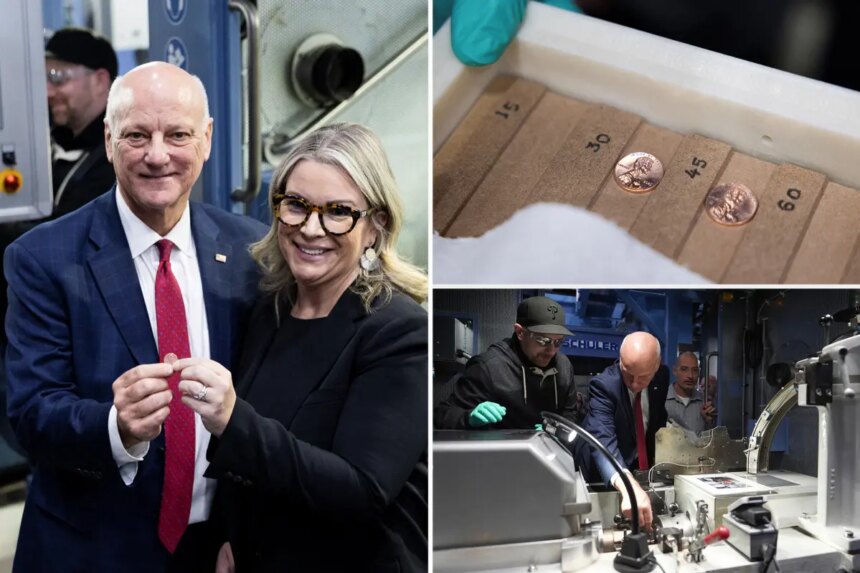
The final U.S. pennies were minted this week, marking the end of a currency that’s been in circulation for over two centuries. Experts estimate that the last pennies produced could sell for a staggering $5 million each when they go up for auction in December.
The historical moment took place at the Philadelphia Mint, where U.S. Treasurer Brandon Beach pressed the button to stamp out the last batch of pennies after 232 years of production. The first pennies were minted in 1793, when Philadelphia was the nation’s capital.
Among those witnessing the event were Beach and Kristie McNally, the acting director of the U.S. Mint. The last five pennies bear a special omega symbol to denote their unique status, which is expected to attract significant interest and competition from collectors when they hit the auction block.
John Feigenbaum, publisher of the rare coin price guide Greysheet, shared his excitement, indicating that collectors would be eager to acquire these modern rarities. He emphasized the pennies’ value as essential to any “complete set” of Lincoln cents, estimating their worth between $2 million and $5 million each.
However, there are varying opinions on their potential auction value. Mike Fuljenz, president of Universal Coin & Bullion, projected that the final penny might bring in up to $1 million, while subsequent pennies could fetch around $10,000 to $20,000 each.
Proceeds from the auction will support the operations of the U.S. Mint, with any extra funds allocated to the U.S. Treasury. In total, the Mint crafted 232 omega-stamped pennies for the auction—one for each year of the penny’s existence. Additionally, three more were created for display at the Treasury and other institutions, alongside 235 gold pennies.
The decision to cease penny production came last February when President Donald Trump criticized its escalating production costs, which surged to 3.69 cents per coin. He deemed the minting process wasteful and projected significant savings for taxpayers, estimated at $56 million annually.
Despite the official end of penny production, Beach reassured the public that the existing pennies will remain legal tender. He encouraged continued use, noting that approximately 300 billion pennies are still in circulation. The Mint plans to continue producing limited quantities of collector versions as well.
As retailers adapt to the shutdown of this coin, some have begun rounding cash transactions to the nearest nickel. For instance, Kwik Trip, a convenience chain in the Midwest, has implemented a policy of rounding down, which could cost the company millions each year.
This shift has sparked legal challenges in areas where exact change is mandated, such as four states and major urban centers like New York and Philadelphia. In response, the National Association of Convenience Stores and other retail organizations have urged Congress for legislative solutions.
Jeff Lenard, a representative for the association, acknowledged the long-standing push for the elimination of the penny but expressed dissatisfaction with how the situation unfolded. As an iconic piece of American currency, the penny has evolved since its inception in 1793, with Abraham Lincoln’s image being introduced in 1909 to commemorate his centennial anniversary—making it the first U.S. coin to feature a president.