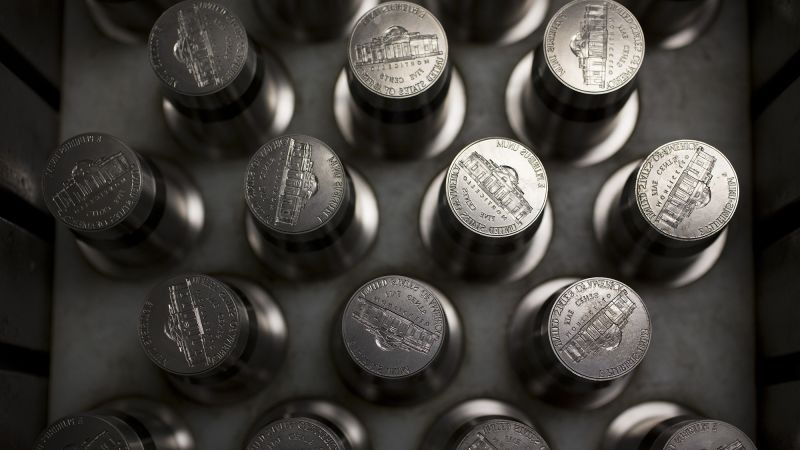
The end of an era has arrived as the U.S. Mint pressed its last pennies in Philadelphia on Wednesday, a decision driven by the rising costs of production that exceed the coin’s face value and its diminishing usefulness. Although pennies remain legal tender, there are already reports from banks and merchants indicating a growing shortage.
The primary factors leading to the cessation of penny production have been magnified in the case of the nickel. Currently, it costs nearly 9 cents to manufacture a nickel, while the cost to produce pennies has reached approximately 5 cents, which is 4 cents more than their actual worth.
The composition of these coins significantly contributes to their production costs. Nickels are made up of 75% copper and 25% nickel, contrasting sharply with pennies, which are primarily composed of zinc with only a thin copper plating. Price fluctuations in these metals can dramatically affect production costs; while zinc prices have remained stable since late 2016, copper and nickel costs have skyrocketed, roughly doubling in recent years.
Efforts are underway to lower the production costs of nickels, with the U.S. Mint and its supplier, Artazn, exploring new manufacturing methods. Mark Weller, executive director of Americans for Common Cents and a proponent of maintaining the penny, indicated that achieving a production cost of less than 5 cents per nickel could be possible within the next year. This would involve creating a “new” nickel that would closely resemble the existing coin.
Nevertheless, production costs are not the only challenge facing the nickel; its utility is being called into question as Americans increasingly turn away from cash transactions. Countries such as New Zealand and Australia have already phased out the production of small-change coins like the nickel and penny, demonstrating a global trend toward currency simplification.
While the decline in cash usage may alleviate some immediate pressure to eliminate the nickel, an economic expert, David Smith, believes that the nostalgia for such coins may slow the transition. He anticipates that the nickel’s eventual removal from circulation is likely, though perhaps 15 or 20 years away.
Weller voiced concerns about the shift toward a cashless economy and its ramifications for lower-income consumers, emphasizing that the transition benefits larger banking institutions and credit card companies, which impose fees that ultimately burden the consumer.
Amidst a nickel shortage, merchants are seeking clarification on whether they are permitted to round cash transactions to the nearest five cents. A potential shift to rounding transactions to the nearest ten cents—rather than five—could lead to significant financial implications, with estimates suggesting it could cost American consumers an additional $56 million annually compared to the lesser impact of rounding to the nearest nickel.
Even if a revised nickel were to be produced at under 5 cents, ongoing production challenges remain, particularly as a significant portion of the costs—approximately 2.8 cents—arise from administrative and distribution expenses rather than raw materials.
Despite the financial losses incurred by the Mint on every penny and nickel produced since 2006, Weller and Smith agree that neither coin is likely to disappear imminently. Weller noted the persistent inquiries he has received regarding the future of the penny over the decades, suggesting that change is unlikely to be swift.