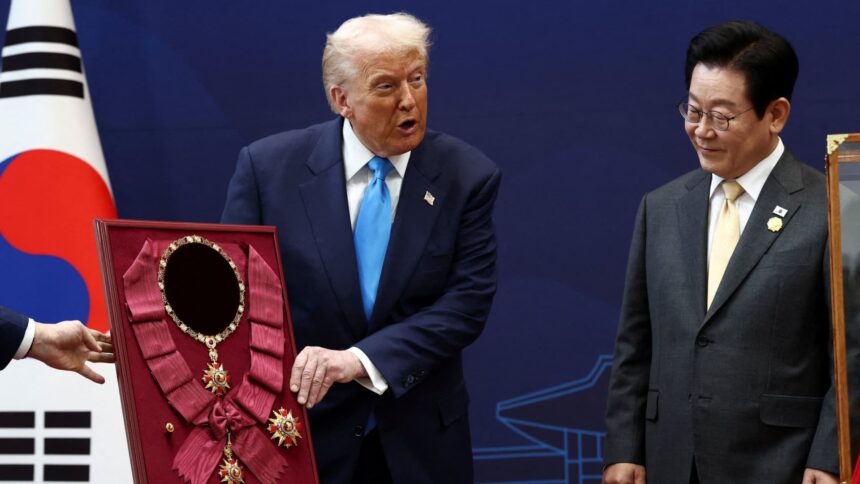
U.S. President Donald Trump received the prestigious “Grand Order of Mugunghwa” from South Korean President Lee Jae Myung during a meeting at the Asia-Pacific Economic Cooperation (APEC) leaders’ summit in Gyeongju, South Korea. The award highlights the strengthening ties between the two nations amid significant discussions on trade.
In a strategic push to boost domestic investment, major South Korean companies announced substantial financial commitments during a meeting with President Lee. This move is seen as a response to potential concerns regarding the prioritization of U.S. investments stemming from a recent trade deal. Just days earlier, Lee’s administration finalized a pivotal agreement with the United States, in which South Korea agreed to invest $350 billion in U.S. industries in exchange for avoiding the highest tariffs proposed by the Trump administration.
Samsung Electronics, a global leader in semiconductor technology, pledged to invest 450 trillion won (approximately $310 billion) over the next five years aimed at expanding its domestic operations. This investment will include the construction of an additional production line at its Pyeongtaek manufacturing hub, designed to meet the soaring demands for semiconductors, particularly driven by the rise of artificial intelligence applications. The new production line is projected to commence operations by 2028 as part of Samsung’s long-term strategy to bolster its memory chip production capabilities. In line with this expansion, the company also plans to establish AI data centers in regions beyond the greater Seoul area, specifically targeting South Jeolla Province and Gumi. This initiative aligns with government aspirations to minimize the developmental disparities between major metropolitan areas and other regions.
Hyundai Motor Company, South Korea’s largest automobile manufacturer, revealed its intention to invest 125 trillion won ($86.3 billion) from 2026 to 2030 to enhance its domestic research and development efforts. The focus will be on pioneering technologies such as artificial intelligence, robotics, and autonomous vehicles, showcasing a commitment to innovation.
Other significant players in the South Korean economy, including SK Group—a leader in the semiconductor sector—as well as shipbuilders Hanwha Ocean and HD Hyundai, declared plans to ramp up domestic investments. These commitments are crucial as South Korea strives to bolster its shipbuilding industry, a focal point emphasized by President Trump during trade negotiations.
During the discussions with corporate leaders, President Lee commended the business sector for being instrumental in the successful negotiation of the trade agreement with the U.S. He urged these companies to continue investing domestically to alleviate fears that they might redirect their capital towards American projects. Lee’s administration is exploring various policy measures, including the potential easing of regulations, to foster a more business-friendly environment.
SK Group Chairman Chey Tae-won noted that plans to invest at least 128 trillion won ($88.3 billion) domestically through 2028, mainly focusing on AI, have been positively influenced by the recent trade agreement, which alleviates uncertainties and allows for more ambitious domestic investments.
The details of the U.S.-South Korea trade agreement revealed a commitment of $150 billion towards the U.S. shipbuilding industry and an additional $200 billion across other American sectors, with a stipulation to cap annual investments at $20 billion to maintain financial stability. In return, the U.S. has agreed to reduce tariffs on South Korean automobiles and auto parts from 25% to 15% and will ensure that tariffs on South Korean semiconductors remain at competitive levels moving forward.