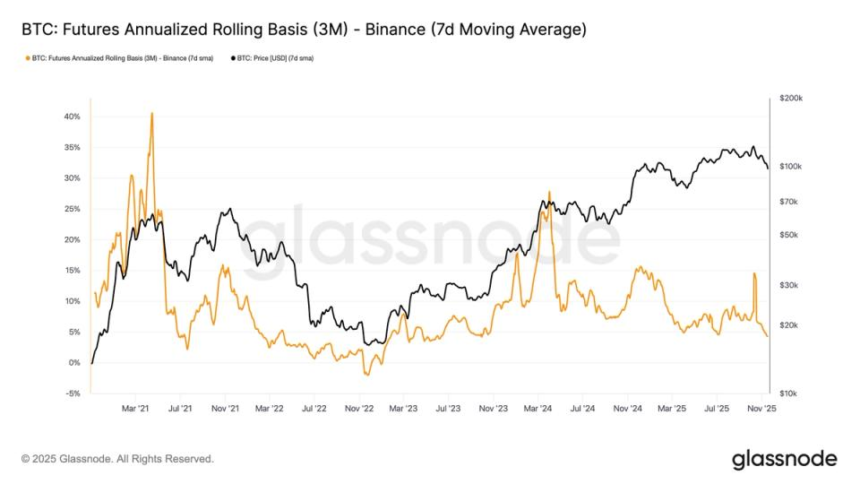
Bitcoin has recently entered a state of backwardation, a phenomenon characterized by futures trading below the spot price. This situation typically arises during periods of market stress, “extreme fear,” or significant hedging activity. The shift to backwardation comes as Bitcoin’s price has plummeted by as much as 30% from its previous all-time high.
Thomas Young, Managing Partner at RUMJog Enterprises, highlighted via an X post that backwardation is an uncommon occurrence in the Bitcoin market, often signaling a critical juncture for traders. Young explained that such setups are indicative of stress, forced de-risking, or a short-term capitulation. From this point, he observes, markets generally follow one of two pathways: a potential reversal as panic subsides, or a continuation leading to further downward movement, which can often signal the market bottoming out.
Historically, backwardation has coincided with significant market lows. Notably, it marked the precise cycle low in November 2022, aligning with Bitcoin’s drop to around $15,000 during the fallout from the FTX collapse. It reemerged in March 2023 when Bitcoin momentarily dipped below $20,000 amid the crisis surrounding Silicon Valley Bank and the USDC depeg, before rebounding significantly. Another instance occurred in August 2023 when news surrounding the Grayscale ETF led to a sell-off, pushing prices down to approximately $25,000—a point that ultimately marked a short-term bottom followed by a quick recovery.
Currently, the annualized rolling basis for three-month futures has fallen to around 4%, its lowest level since November 2022. This basis measures the potential annualized return from a basis trade, where traders simultaneously buy spot Bitcoin and sell a futures contract maturing in three months. Typically, futures are priced at a premium; however, the current decline indicates a sharp reduction in demand for leveraged long exposure.
In periods of bullish sentiment, traders are usually willing to pay for forward exposure, leading to higher basis levels—peaking at 27% in March 2024 during Bitcoin’s all-time high of $73,000. The present decline signifies a more cautious market environment, reflecting a softer risk appetite amid ongoing adjustments following the significant price decreases. While moments of exuberance can push the market into steep contango, Bitcoin usually operates within a relatively mild contango structure during more stable periods.