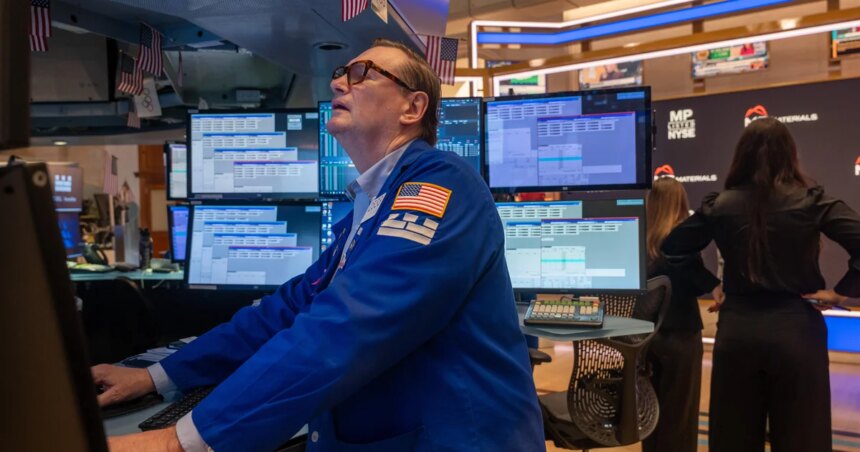
The U.S. stock market experienced a notable decline in early trading as investor concerns regarding the sustainability of the artificial intelligence boom intensified. The S&P 500, which recently peaked in late October, saw a decrease of 78 points, or 1.2%, trading at 6,594 approximately an hour after the market opened. The Dow Jones Industrial Average and the tech-heavy Nasdaq Composite also faced losses, dropping 1.2% and 1.6%, respectively. Despite the setbacks, the S&P 500 remains up more than 12% for the year, with the Dow adding 8% and the Nasdaq rising over 15%.
Nvidia, a key player in the AI sector, has been a significant drag on the market, with a notable 3.2% dip, bringing its monthly losses close to 11%, which places it in “correction” territory—a condition defined by a stock’s decline of at least 10% from its previous peak. The company’s third-quarter financial results are scheduled to be announced on Wednesday, which has only added to investor anxiety. Market analyst Adam Crisafulli from Vital Knowledge indicated in a research note that the market’s loss is a reflection of ongoing pessimism as investors reduce their exposure to technology stocks.
Nvidia’s impact on the market cannot be overstated; it holds immense sway on Wall Street due to its market cap. At one point, the company was valued at over $5 trillion, driven largely by heightened demand for its AI chips. John Higgins, the chief markets economist at Capital Economics, noted that the surge in AI interest has been so pronounced that without it, the S&P 500 might currently be closer to the 5,000 mark. This raises questions among investors about the durability of the gains made by tech giants driving this technological shift.
This downturn contrasts sharply with the months of aggressive rallying seen since April, following a market sell-off triggered by unexpected tariffs from former President Donald Trump. However, critics argue that this rapid rise may have resulted in stock prices becoming overly inflated, making them vulnerable to sharp corrections, especially in sectors fueled by AI enthusiasm.
Nonetheless, a significant number of large investors remain optimistic regarding a stock market recovery, as indicated by Bank of America Global Research’s latest monthly survey of global fund managers. However, when considering potential risks, 45% pinpointed an AI bubble as the foremost concern, surpassing worries regarding the bond market, inflation, and trade disputes. This survey also showed that the highest net percentage of investors in two decades believe that companies are overinvesting in the AI sector, raising alarms that the current investment surge in AI chips and data centers might not yield the revolutionary outcomes many have anticipated.
Other speculative areas within the market are experiencing turbulence as well; for instance, Bitcoin’s value recently dropped below $90,000, significantly lower than its price of nearly $125,000 just a month prior. Similarly, shares of Cloudflare fell by 3.1% following a technical issue that disrupted services for ChatGPT and other platforms.
In related financial metrics, Treasury yields saw a slight decline, with the yield on the 10-year Treasury bond easing to 4.09%, down from 4.13% at the end of the previous day. This indicates a mixed atmosphere in the broader financial markets as investors navigate through uncertainties surrounding technology investments and economic policies.