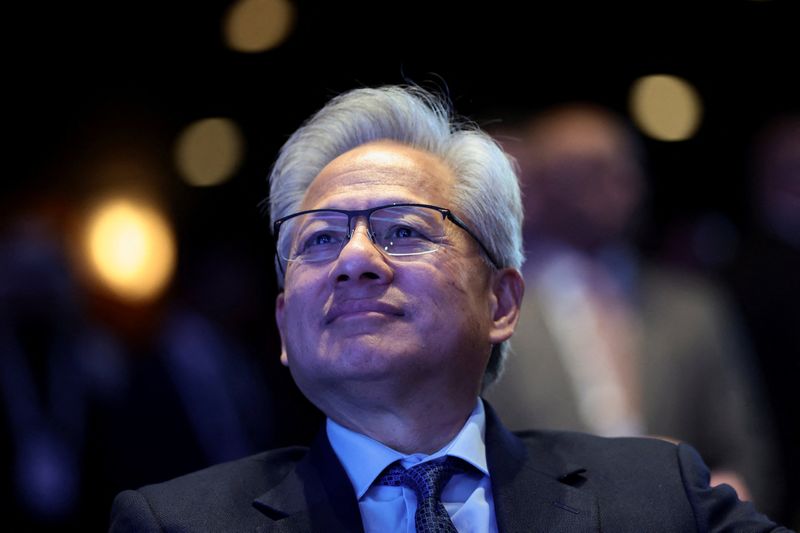
In a striking assertion during a recent earnings call, Nvidia CEO Jensen Huang declared that he perceives the current state of artificial intelligence not as a bubble, but rather as a critical tipping point for the industry. Huang envisions that Nvidia’s specific computing capabilities will influence an array of applications, ranging from coding to the operation of robots integrated into daily life.
Despite Huang’s optimistic outlook, skepticism is mounting among market analysts, who express concern that the purported tipping point could lead to a downturn. Nvidia recently reported third-quarter results and forecasts that exceeded expectations, alleviating immediate worries. However, analysts caution that ongoing growth may be jeopardized by factors beyond Nvidia’s control, detracting from its status as a top market player, currently valued at over $4.5 trillion.
A regulatory filing from Nvidia revealed a significant dependency on a concentrated customer base; 61% of the company’s revenue—totaling $57 billion—originated from just four unnamed customers, indicative of an increase from 56% in the previous quarter. Rumors suggest that these could include well-known giants like Microsoft, Meta, and Oracle. Additionally, Nvidia has ramped up its expenditure on renting back its own chips from cloud customers to $26 billion, a substantial rise from $12.6 billion reported in the prior quarter, with contracts in place extending to at least 2031. The company previously announced investments of up to $100 billion in OpenAI and $10 billion in Anthropic, further emphasizing its entanglements with a select few clients.
Market concerns are heightened by the fact that many of these key customers have not yet achieved significant profits from their AI ventures. Analyst Chaim Siegel from Elazar Advisors pointed out that much of the current growth is attributed to loss-making projects, suggesting that unless these companies collectively curtail spending, a potentially negative cycle could ensue.
Countering speculation of an AI bubble during the earnings call, Huang articulated three core transitions through which he believes Nvidia is positioned to thrive. The first involves migrating non-AI software applications, such as engineering simulations and data science, from traditional processors to Nvidia’s advanced chipsets. The second concerns the creation of innovative software categories, including coding assistants. Ultimately, Huang predicts a shift of AI applications from the digital realm into tangible realms, impacting areas such as automotive and robotics.
Despite these optimistic projections, concerns persist regarding the infrastructure required to support such rapid growth, specifically in terms of land and power resources. Even Nvidia proponents, like Ivana Delevska, chief investment officer at Spear Invest, acknowledge the challenges involved. To address these concerns, Huang stated that Nvidia is actively forming partnerships focused on land acquisition, power supply, and data center development, emphasizing that while these issues are complex, they are manageable.
However, as competitors like Alphabet and Amazon design their own AI chips to cater to similar markets, analysts are apprehensive about Nvidia’s ability to maintain its dominant position. Jay Goldberg, senior analyst at Seaport Research Partners, raised doubts regarding Nvidia’s future prospects, noting that their product is essentially sold out for the current and upcoming year, prompting uncertainty about potential upside surprises. “The list of things that could go wrong for Nvidia is longer than the list of things that could go right,” he remarked, highlighting the precarious nature of the company’s ambitious expansion plans.