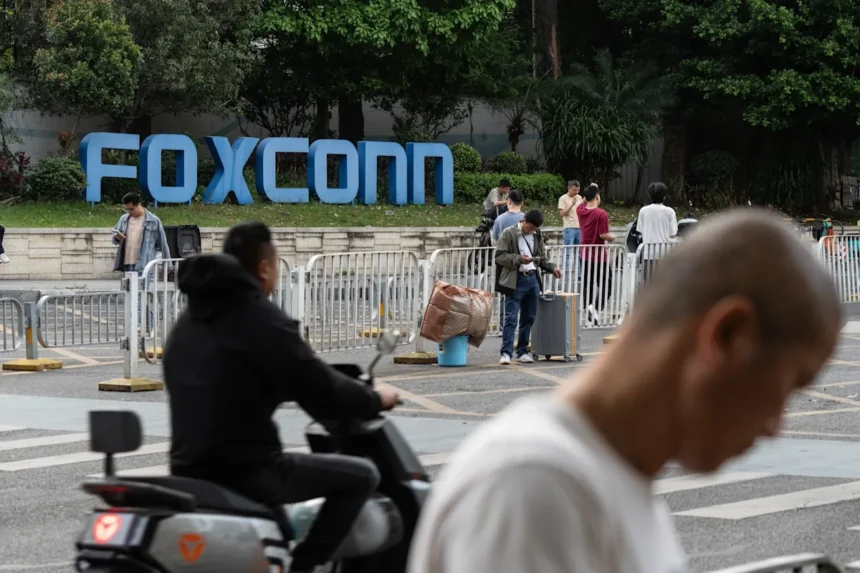
Hon Hai Precision Industry Co., widely known as Foxconn, has announced a significant investment plan to enhance its manufacturing capabilities in the United States, targeting an expenditure between $1 billion to $5 billion. This strategic expansion is primarily aimed at meeting the surging demands of major players in the artificial intelligence (AI) sector, including Nvidia Corp. and OpenAI.
In a recent development, Foxconn revealed a collaborative partnership with OpenAI focused on co-designing server systems tailored for AI applications. During an interview with Bloomberg Television, Foxconn Chairman Young Liu emphasized the importance of this partnership, particularly in addressing the challenges associated with deploying AI data centers effectively. “For OpenAI, they’re the largest user of AI compute and they have a lot of experience with what can go wrong,” Liu remarked, highlighting the joint effort to innovate new architectures for AI data centers to overcome existing operational hurdles.
The collaboration will see both companies working together on server rack designs that can be locally manufactured within the U.S. Foxconn plans to produce essential components for data center facilities, including cabling and power systems, effectively increasing its domestic production capacity. Liu projected that by 2026, Foxconn would be capable of assembling up to 2,000 server racks weekly.
While detailed purchase agreements related to the OpenAI partnership were not disclosed, Liu noted the extensive prior collaboration, including discussions with OpenAI CEO Sam Altman at Foxconn’s headquarters in Taiwan. They exchanged insights about the prevalent issues faced by AI data centers today.
This move aligns with Foxconn’s broader strategy to expand its influence and market share within the AI hardware ecosystem, as the company seeks to diversify its business beyond its longstanding role in assembling iPhones for Apple Inc. Foxconn is also involved in OpenAI and Oracle Corp.’s Stargate project, which concerns the operation of a server production site owned by SoftBank Group Corp.
Moreover, OpenAI has been actively engaging in a $500 billion initiative to bolster U.S. data center and AI infrastructure, a plan that gained momentum shortly after the return of Donald Trump to the White House. Foxconn’s expansion into the U.S. server market not only serves to meet governmental demands but also aids in mitigating risks associated with tariffs.
In addition to its AI initiatives, Foxconn unveiled a new electric vehicle model, the Model A, set to be manufactured in Japan, alongside a collaboration with Intrinsic to explore advancements in smart factories utilizing robotics. This comes at a time when the significance of robotics is escalating, particularly as industries recognize the transformative potential of automation. Liu pointed out that while much of factory work currently relies on simple automation, there is an emerging opportunity for advanced robotics to take on more complex tasks, completing the remaining percentage of work that previously required human input.
Liu expresses confidence in the company’s ability to pivot towards these developments, citing the already high levels of automation in its production lines which have set the foundation for future ventures into robotics. The landscape of AI and robotics continues to evolve, presenting significant opportunities as leaders such as Nvidia foresee a trillion-dollar market potential in these sectors.