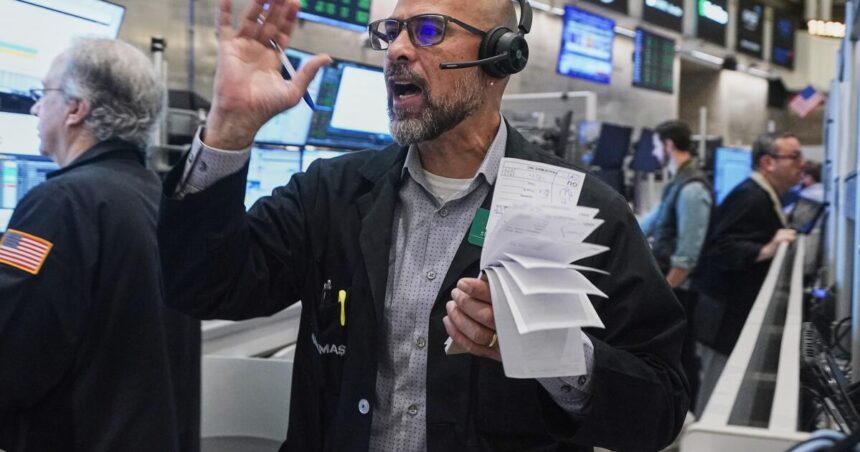
Wall Street experienced notable volatility on Friday, but ultimately closed the day with gains across major indices. The Standard & Poor’s 500 index bounced up and down throughout the morning but managed to rally nearly 2% before settling at a 1% increase by the day’s end. The Dow Jones industrial average gained 493 points, or 1.1%, while the Nasdaq composite rose by 0.9%.
This positive outcome marked a significant end to a week where the S&P 500 hovered just 4.2% below its all-time high. However, the fluctuations in stock prices were some of the most intense that investors had experienced since a sell-off in April, creating an environment of uncertainty as they dealt with sharp intraday swings. The core questions driving this volatility revolve around whether the valuations of high-profile stocks like Nvidia and Bitcoin have become inflated, and whether the Federal Reserve has reached the end of its interest rate cuts—a move that could have significant impacts on the economy and investment returns.
Investors found some reassurance in a speech from John Williams, president of the Federal Reserve Bank of New York. During a conference in Chile, he indicated that there may be “room for a further adjustment” to interest rates, which suggests he might support another rate cut in December. Given the previous expectations for a series of rate reductions that had propelled stock prices to record highs, the actions of the Federal Reserve are critical for market sentiment. Nevertheless, other Federal Reserve officials have expressed skepticism about further rate cuts due to persistent inflation concerns, contributing to elevated market volatility.
The asset class known for most recent excitement, artificial intelligence (AI), continued to influence stock movements. Nvidia, a key player in this sector, saw its stock initially rise but then fall by 4.3%, ultimately closing down 1%. Concerns linger about the long-term profitability of the AI investments made by companies like Amazon and Meta Platforms, prompting caution among some investors.
Despite the volatility in tech-related stocks, the majority of stocks on Wall Street rose, with nearly 90% of S&P 500 companies advancing. Larger tech companies often overshadow smaller movements within the market, which can create an impression of broader weakness when they perform poorly. Brian Jacobsen, chief economist at Annex Wealth Management, noted that when major companies drive most of the losses, it can skew perceptions of the overall market health.
Retail stocks set a positive tone on Friday. Gap Inc. surged by 8.2% after exceeding profit expectations, driven by strong sales trends across its various brands, including Old Navy and Banana Republic. Similarly, Ross Stores saw an 8.4% increase after reporting broad-based growth and revising its sales forecasts upward for the holiday season.
Homebuilders also experienced gains, fueled by hopes of lower interest rates making mortgages more affordable, thereby boosting the housing market. Stocks like D.R. Horton, Lennar, and PulteGroup saw increases of 6.8%, 5.9%, and 5.2%, respectively.
In total, the S&P 500 gained 64.23 points to close at 6,602.99, while the Dow Jones industrial average increased by 493.15 to 46,245.41, and the Nasdaq composite finished at 22,273.08 after rising 195.03 points.
In the bond market, Treasury yields declined amidst speculation of possible rate cuts by the Federal Reserve. Market predictions shifted to a 72% likelihood of a December cut, a notable rise from 39% just a day earlier. Consequently, the yield on the 10-year Treasury dipped to 4.06%, down from 4.10% the previous evening.
International markets reacted to the volatility seen on Wall Street, with mixed results across Europe and significant declines in Asia. Japan’s Nikkei 225 dropped by 2.4%, while South Korea’s Kospi fell by 3.8%, highlighting the reverberating effects of U.S. market dynamics.