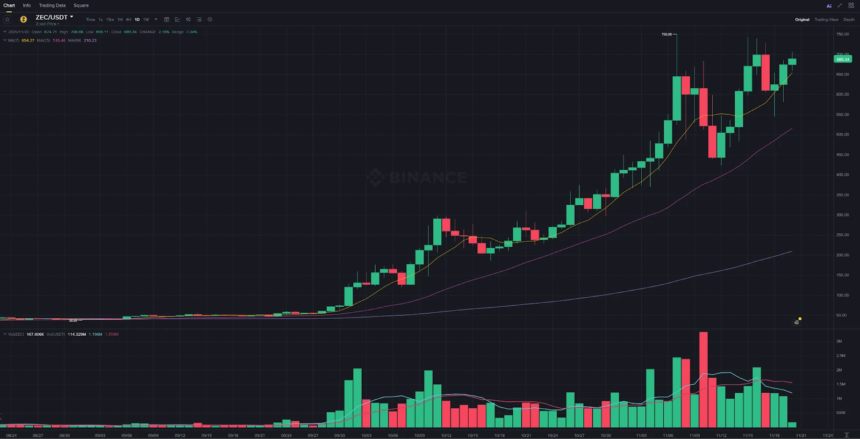
Zcash (ZEC) has experienced a sudden surge in value, drawing attention amidst recent critical events in the blockchain space. This revival of interest in ZEC is noteworthy not only for its market implications but also for its timing—coinciding with the release of Vitalik Buterin’s “Trustless Manifesto” and a significant outage at Cloudflare that disrupted approximately 90% of Web3 projects.
On November 14th, an internal configuration failure at Cloudflare rendered around 20% of its globally hosted websites inaccessible for several hours. Notably, popular platforms like X and OpenAI were affected, highlighting an ironic truth: many decentralized Web3 projects that claim to offer trustless environments are, in practice, reliant on centralized infrastructure providers such as Cloudflare. This outage underscored a troubling aspect of the blockchain ecosystem, revealing the dependence of various blockchain service providers on centralized services for crucial operational components like RPCs (Remote Procedure Calls) and APIs. Over the past year, several Rollup Sequencers have increasingly relied on centralized hosting, and user expectations for streamlined experiences have further eroded the principles of decentralization.
In stark contrast to this trend, ZEC emerged as a beacon advocating for privacy and trustlessness—a cornerstone principle of the cryptocurrency space. ZEC’s resurgence reflects a market sentiment that is reevaluating the importance of decentralization in light of recent compromises in the Web3 landscape. The emotional response from investors signals a demand for platforms that genuinely uphold trustless principles, rejecting the convenience of centralized solutions.
Buterin’s “Trustless Manifesto” lays out three critical red lines that he believes the industry must adhere to: no critical secrets, no indispensable intermediaries, and no unverifiable outcomes. Buterin posits that violating any of these principles categorizes a project as a platform—privatized and non-neutral—rather than a true protocol. This has raised essential questions about how many current blockchain projects can genuinely meet these standards, especially in an environment where centralized solutions have become commonplace.
As the need for trustlessness evolves, experts suggest that the solution lies in “verifiable computing.” Simply relying on nodes and peer-to-peer networks is no longer deemed sufficient—today’s trustlessness must navigate the challenges of extensive computations, intricate cross-chain interactions, and the need for high-speed transactions, all while safeguarding layer one security. The industry has come to a consensus: execution should not rely on any intermediary; instead, verifiable cryptographic proofs are required.
Innovative projects are making strides in this direction. zkSync and Starknet are employing zero-knowledge proofs for Layer 2 executions, while EigenLayer uses restaking to leverage Ethereum’s security. Celestia introduces data availability sampling to empower light clients. These initiatives promote a model where users are not merely placing trust in operators but are relying on sound mathematics and cryptography that catch malicious conduct—effectively minimizing the cost of verification.
A noteworthy player in the verifiable computing realm is Succinct. Its SP1 Hypercube zkVM, powered by cutting-edge GPU technology, has demonstrated a groundbreaking capability in processing Ethereum blocks. In tests, this technology has shown a remarkable presence of efficiency in generating proof for a majority of L1 blocks within minimal timeframes. This capability signifies a shift toward a decentralized model that can function without intermediaries, allowing for near-real-time interaction between native rollups and Ethereum’s layer one.
The security of zkVMs is a continuing concern, with most relying on the mathematical “Proximity Gap” assumption. However, recent research challenges this assumption, positioning Succinct’s approach to completely dissociate from it. This alignment with Buterin’s manifesto, alongside formal verification of RISC-V constraints, represents a significant leap toward achieving robust security solutions.
As ZEC’s rising value signals a yearning for the core principles of cryptocurrency, Vitalik’s manifesto lays out a blueprint for the future, while Succinct’s technological advancements demonstrate a feasible approach to achieving these ideals. The crypto industry is now at a bifurcation point: it can either pursue higher transactions per second at the expense of trust or embrace a more challenging path that remains true to the trustless ethos foundational to blockchain.
Ultimately, ZEC serves as a reminder of the original intentions of the cryptocurrency movement. Buterin’s insights encourage a return to integrity and verifiability, while Succinct’s innovations pave the way for a more secure and trustless blockchain environment. The competition of the future will likely focus less on sheer speed and more on efficiently performing computations with minimal trust dependencies.