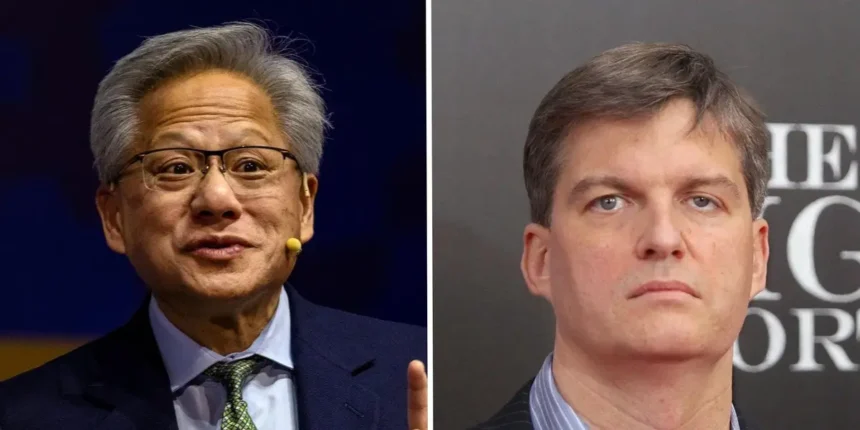
Michael Burry has intensified his critique of Nvidia and other leading AI companies, revealing his decision to short both Nvidia and Palantir. In a recent post on his Substack, the investor known for his role in “The Big Short” criticized a memo issued by Nvidia to Wall Street analysts, asserting it was a response to claims he never made. Burry expressed disbelief that such a document could have originated from the world’s most valuable public company, characterizing it as filled with “one straw man after another,” and suggesting that the memo “almost reads like a hoax.”
Burry, who has recently closed his hedge fund to outside investors to focus more on writing, clarified that he had never implied Nvidia was manipulating the depreciation of its property, plant, and equipment (PP&E). He pointed out that, as a primarily chip design firm with minimal capital expenditures, this aspect was irrelevant in evaluating Nvidia. “No one cares about Nvidia’s own depreciation,” he remarked, emphasizing that this argument was misleading.
He further dismissed Nvidia’s claim that its older-generation chips continue to be utilized. Instead, Burry remarked that his real concern lay in the potential for newer chips to become functionally obsolete within the next few years, between 2026 and 2028. He noted, “I am looking forward because I see problems that are relevant to investors today,” effectively countering Nvidia’s assertions.
Describing Nvidia’s response as “disingenuous on the face, and disappointing,” Burry disclosed that he has maintained positions against both Nvidia and Palantir, although he hinted that a more comprehensive discussion on Palantir would come at a later time. Nvidia has yet to respond to requests for comments regarding Burry’s latest critiques.
One of Burry’s primary concerns pertains to the accounting practices of AI companies, particularly how they manage asset depreciation. He explained that firms can artificially boost short-term profits by prolonging the projected lifespan of their assets. This could lead to significant writedowns in the future due to inflated asset valuations. He referenced a recent interview with Microsoft CEO Satya Nadella, in which Nadella mentioned that he had delayed the company’s data center expansion due to concerns over possibly overbuilding infrastructure that would soon become outdated.
Burry further noted that hyperscale data centers have been increasingly extending the useful life of their chips and servers for depreciation accounting, amidst substantial investments in graphics chips that face planned obsolescence. He seemed to suggest that the fallout from his depreciation commentary has led to a broader discussion than he had anticipated, remarking, “I have been drawn into something much bigger than me.”
In recent weeks, Nvidia’s stock has fallen 14% from its peak on November 3, as investor sentiment turns wary regarding the potential overvaluation and overspending within the AI sector. Burry became widely recognized after his successful bet against the U.S. housing bubble, a story that gained widespread attention through the book and subsequent film “The Big Short.” Known for his warnings about economic downturns, he returned to social media in late October, asserting that AI stocks could be entering a bubble.
His firm, Scion Asset Management, previously disclosed that it held bearish put options on Nvidia and Palantir with a combined notional value of $1.1 billion as of the end of September. Burry clarified that these investments required a relatively modest capital outlay, amounting to about $10 million each.