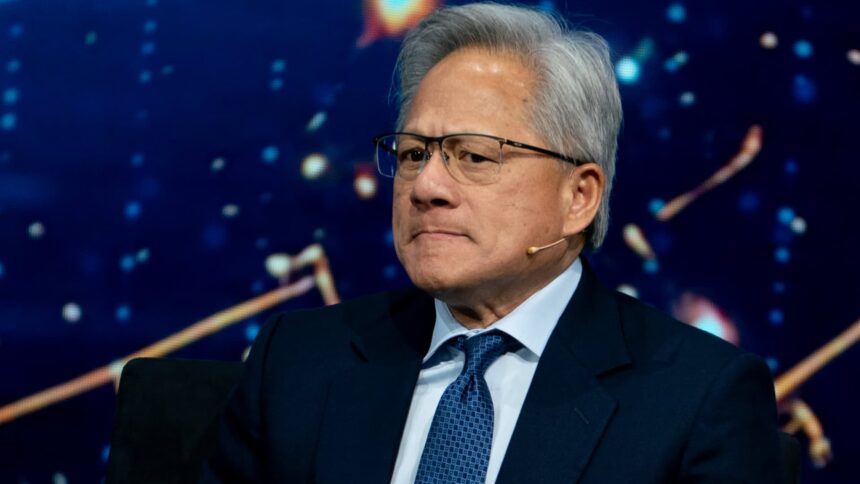
Jensen Huang, the CEO of Nvidia Corp., spoke at the US-Saudi Investment Forum in Washington, DC, recently, a gathering that highlights the growing intersection of technology and global investment strategies. This comes at a pivotal time as competition within the artificial intelligence sector intensifies.
In recent trading sessions, the shares of Nvidia and Alphabet, the parent company of Google, have shown contrasting trajectories. Following Alphabet’s unveiling of its upgraded AI model, Gemini 3, share prices surged to all-time highs, contributing to renewed enthusiasm among investors. This optimism was further fueled by reports that Meta is considering acquiring AI chips from Alphabet, heightening speculation surrounding the tech giant’s position in the AI landscape.
Conversely, Nvidia’s stock faced a setback, declining by over 2% recently. In response, the company sought to reaffirm its supremacy in AI technology, contending through a social media statement that it remains “a generation ahead of the industry.” Nvidia emphasized its role as a key supplier for Google while asserting the superiority of its chips over competitors. Although Alphabet shares showed a slight increase in premarket trading, Nvidia’s stock continued to falter.
In broader market news, the stock market saw a notable rally with the Dow Jones Industrial Average gaining over 660 points, or 1.4% in a single day. Investors are increasingly optimistic about possible interest rate cuts at the upcoming Federal Reserve meeting in December, with futures traders assigning an 84% probability to a rate decrease. This marked a significant rise in just one week, reflecting changing sentiments among market participants. Speculation about potential leadership changes at the Fed, especially with White House officials advocating for further cuts, has contributed to this shift.
On the geopolitical front, recent discussions indicate that Ukraine is moving forward with a US-backed framework aimed at resolving its ongoing conflict with Russia. During a press conference, President Trump stated that progress is being made towards a peace deal and plans to meet with both Ukrainian President Zelenskyy and Russian President Putin once critical agreements are finalized. However, a Kremlin spokesperson indicated that no official agreement has been received yet, as diplomatic talks continue with U.S. envoy Steve Witkoff set to meet with Putin next week.
In the investment community, notable trader Michael Burry, famed for his prescient predictions leading up to the 2008 financial crisis, has expressed concerns about the sustainability of the AI market. Through a newly launched blog, Burry argues that the current AI boom resembles a speculative bubble, echoing sentiments from former associates about the inadequacy of infrastructure costs relative to industry growth. In a pushback, Nvidia has circulated a memo to analysts rebutting Burry’s assertions directly.
In real estate, signals of concern are evident as a significant number of homeowners are withdrawing their properties from the market. Data reported by Redfin indicated that nearly 85,000 sellers delisted their homes in September, representing the highest number for that month in eight years. Factors such as sluggish buyer demand, decreasing home prices, and economic uncertainty appear to be prompting sellers to reconsider their decisions. Additionally, a declining Consumer Confidence Index, the lowest since April, underscores growing apprehensions about job prospects and economic stability.
The current financial landscape is marked by a blend of technological advancements, shifting market sentiments, and evolving geopolitical dynamics, all of which are crucial for investors to consider as they embark on their trading strategies.