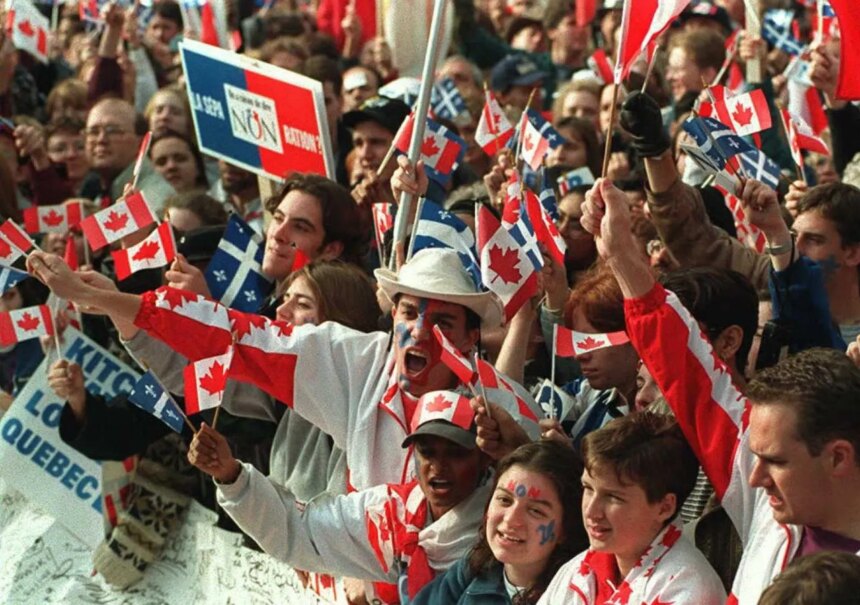
In a significant demonstration of political sentiment, approximately 150,000 Canadians gathered in Montreal on October 27 to rally against the secessionist movement in Quebec, ahead of a crucial referendum scheduled for October 30. Among the attendees, Prime Minister Jean Chretien is expected to address the crowd, emphasizing the importance of unity within Canada and urging Quebeckers to vote against separation.
The rally exemplifies the complex interplay of national identity and political dynamics in Canada, particularly in the context of Quebec’s ongoing discussions about independence. Demonstrators are rallying not only to oppose secession but also to affirm their Canadian identity, showcasing the deep-rooted emotions that accompany regional and national affiliations.
In a related discussion on democracy, the recent referendum in Switzerland offers an intriguing case study. Despite being hailed as one of the world’s most institutionalized direct democracies, the Swiss referendum system revealed unexpected outcomes that challenge conventional wisdom about majority decision-making. A proposed federal inheritance tax on significant wealth transfers failed to garner support, as nearly 80% of voters rejected it. This outcome sparked surprise among observers, highlighting how labels can often distort public perception.
The voting populace in Switzerland, known for its direct engagement with political questions, demonstrated that their decision-making is heavily influenced by systemic considerations rather than just the specifics of a proposal. The inheritance tax would have targeted a minuscule segment of the population—approximately 2,500 individuals possessing wealth over CHF 50 million. However, the rejection signifies a deeper concern regarding national identity and stability rather than mere redistributive preferences.
In contrast to the United States, where similar measures might falter within broader legislative packages, Switzerland’s unbundled approach—where specific questions are posed directly to the electorate—allowed voters to weigh the implications of the tax against the integrity of their federal system. The proposed tax was perceived not only as a financial measure but as a potential alteration of Switzerland’s federal structure, particularly by centralizing authority that traditionally resides with the cantonal governments.
Swiss political culture places a high value on continuity and predictability, with citizens prioritizing long-term institutional stability over recalibrating wealth distribution. This sentiment reflects a widespread understanding that changes impacting tax authority could signal larger transformations within the nation’s governance framework. In this context, the rejection was as much about preserving the unique Swiss model of federalism as it was about the implications for affluent households.
Ultimately, the case in Switzerland underscores how the terminology and framework surrounding political proposals can lead to misinterpretations of voter intent. Labels—often simplifying complex issues—can obscure the underlying motivations and fears of the electorate. The outcomes of political decisions are shaped by identity, institutional memory, and perceptions of national stability, suggesting that a deeper analysis is necessary for understanding voter behavior in democratic systems. As seen in both the Canadian and Swiss examples, the interplay of national identity and institutional logic can significantly influence the direction of political outcomes beyond simple majority rules.