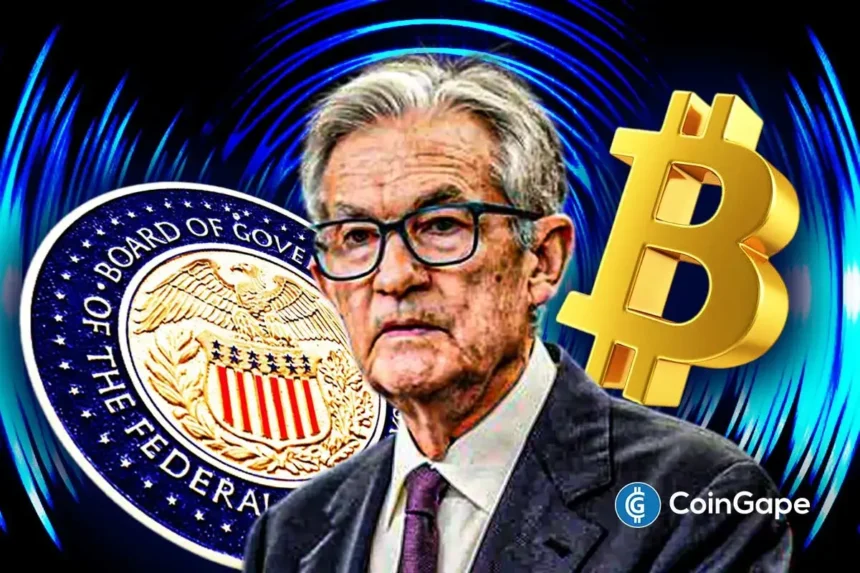
Bitcoin experienced a modest rebound following comments from Federal Reserve Chair Jerome Powell at a recent event, where he notably refrained from discussing current economic conditions or monetary policy. This announcement came during his opening remarks at Stanford University, commemorating the late economist and statesman George Shultz. Powell explicitly stated, “Just to be clear, I will not address current economic conditions or monetary policy,” a refrain familiar to observers as it aligns with his previous statements indicating uncertainty surrounding a potential rate cut in December.
The timing of Powell’s comments coincided with the Fed’s blackout period leading up to next week’s Federal Open Market Committee (FOMC) meeting, which restricts commentary to prevent any influence on financial markets ahead of official decisions. This event also marked the conclusion of the Fed’s quantitative tightening measures, making Powell’s restraint particularly relevant as any direct commentary could have influenced liquidity flows amid the anticipated shift towards quantitative easing.
Amidst these developments, economic indicators have raised questions about the possibility of a rate cut. Recent data from the ISM Manufacturing Purchasing Managers’ Index (PMI) revealed that the manufacturing sector has contracted for nine consecutive months. The November ISM Manufacturing PMI registered at 48.2—lower than the forecasted 48.6 and represents the weakest figure in four months. This downturn is attributed to dwindling orders and rising prices, a situation exacerbated by tariff impacts, fueling speculation that the Federal Reserve may cut rates in their December decision. Current estimates from the CME FedWatch Tool suggest there is an approximately 87% probability of a 25 basis points rate cut, reflecting widespread market expectation.
Commentary from financial analysts, such as Joe Saluzzi of Equity Market Structure Research, suggests a cautiously optimistic view, indicating a potential for a gradual upward trend in market performance as the year draws to a close. Further complicating matters, news has surfaced regarding White House economic adviser Kevin Hassett emerging as a top candidate to succeed Powell, which reignites optimism for more accommodative monetary policy moving forward.
In response to these dynamics, Bitcoin’s price rose over 2% within a 24-hour period, trading at $86,970. The cryptocurrency hit a low of $83,862 and a high of $87,325 during this timeframe. Trading volume has remained robust, driven by a “buy-the-dip” sentiment among traders. However, the derivatives market presents a mixed picture, with Bitcoin futures open interest increasing by 0.25% to $57.70 billion. Notably, futures open interest saw a rise on the Chicago Mercantile Exchange (CME) but witnessed declines on platforms such as Binance and Bybit.
As market participants await the outcome of the upcoming FOMC meeting, sentiments in the cryptocurrency arena remain closely tied to broader economic indicators and Fed policy signals.