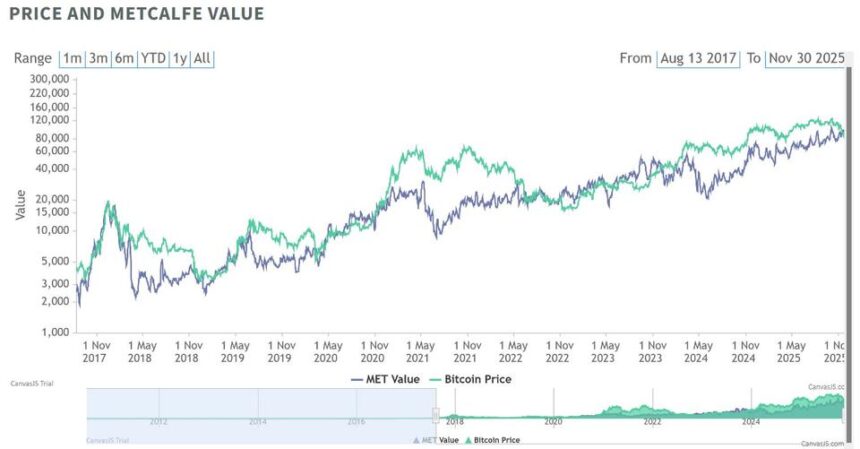
Bitcoin recently experienced a notable downturn, slipping below its network value as determined by Metcalfe value modeling for the first time in almost two years. This analysis, presented by network economist Timothy Peterson, indicates that such a movement often signals the latter stages of market resets. Peterson emphasized that while this does not guarantee a market bottom, it does suggest that a significant amount of leverage has been eliminated, and the speculative “bubble” surrounding Bitcoin has started to deflate.
The decline below the Metcalfe value notably coincided with a substantial pullback in Bitcoin’s price, which experienced a dramatic drop of approximately 36%, bringing it down to around $80,000. This correction effectively drained excess leverage and unwound speculative positions, preparing the market for a potential rebound. Following this period of volatility, Bitcoin managed to recover its value, climbing back above the $90,000 mark as buying interest resurfaced and network conditions began to stabilize.
Historically, Bitcoin has struggled during bearish phases, particularly in 2022 when it traded below its Metcalfe value for the entirety of that bear market. During this time, both market activity and sentiment waned significantly. However, the beginning of 2023 saw a new cycle emerge, with Bitcoin regularly trading above its Metcalfe value due to increased participation and fresh capital inflows. The recent price correction marked the first significant deviation from this trend.
In terms of future projections, periods when Bitcoin has traded below its Metcalfe value have historically yielded strong forward returns. According to Peterson’s analysis, 12-month performance in such conditions has been positive 96% of the time, with an average gain of 132%, significantly outpacing returns during other periods.
Meanwhile, there has been a noticeable increase in long-term holder (LTH) supply, which has surged by about 50,000 BTC over the past ten days. Long-term holders, defined as those who have maintained their Bitcoin for at least 155 days, have become a crucial factor in price dynamics. Previously, this group had contributed to selling pressure over the last year, but the current trend shows that these holders are now accumulating Bitcoin rather than distributing it. As coins transition from speculative short-term hands into LTH wallets, the resultant reduction in sell-side pressure is expected to provide substantial support for Bitcoin’s price in the near term.