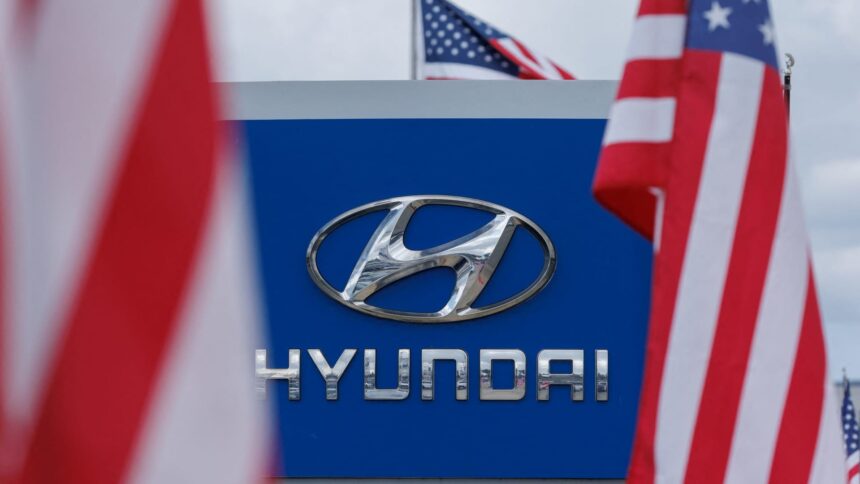
American flags were seen fluttering outside a Hyundai dealership in Irvine, California, as the automotive industry anticipates significant shifts in import tariffs. Hyundai Motor and General Motors (GM) are positioned to gain considerably from a recent announcement regarding the lowering of U.S. tariffs on vehicle imports from South Korea, moving from a steep 25% to 15%. This adjustment, confirmed by the Trump administration, is part of a broader trade agreement aimed at enhancing economic ties between the U.S. and South Korea.
Hyundai, the largest U.S. importer of vehicles from South Korea, disclosed in a recent report that the tariffs have had a severe financial impact, costing the company approximately 1.8 trillion won (around $1.2 billion) in the third quarter of this year. This marked a troubling increase from an earlier figure of 828 billion won ($565 million). Meanwhile, GM has indicated that their exposure to tariffs—stemming primarily from South Korea and Mexico—could reach between $3.5 billion and $4.5 billion in 2025. However, GM’s Chief Financial Officer Paul Jacobson noted that the projected costs have decreased as the company adapts, expecting the figure to come in closer to $1 billion or less in 2026.
The positive shift in tariff rates is welcomed, especially as Hyundai and GM navigate an evolving landscape of international trade. Jacobson shared at a UBS conference that while the reduction offers some relief, the company’s initial expectations of $2 billion in tariff costs may not materialize as anticipated, thanks to various offsetting measures.
The agreement coincides with South Korea’s commitment to invest approximately $350 billion in the U.S. over the coming years, further solidifying the economic partnership between the two nations. U.S. Commerce Secretary Howard Lutnick emphasized that this investment pledge underscores the strengthening relationship and its benefits for American jobs and industry.
Hyundai North America’s CEO Randy Parker highlighted that although the challenges posed by tariffs persist, moving to a 15% rate is a substantial milestone. He expressed optimism for maintaining record sales in the U.S. market in 2026, despite the ongoing complexities associated with international trade agreements.
Hyundai’s growth trajectory in the U.S. has been notable, with an increase in operations and sales, yet the bulk of its vehicles—around 951,000 anticipated for 2025—are still imported from South Korea. This trend positions South Korea as a key player in U.S. vehicle sales, representing about 8.6% of the market based on GlobalData estimates.
Moreover, GM is also expected to import around 422,000 vehicles from South Korea, marking a rise from the previous year’s figures. The automaker has been leveraging South Korean production facilities to manufacture popular entry-level models, contributing to a growing segment of their U.S. sales. GM has articulated the importance of these international operations, highlighting that the entry-level crossovers produced in South Korea are critical to their overall growth strategy.
The recent agreement comes against a backdrop of tension, following a controversial immigration raid at a joint Hyundai-LG Energy Solution battery plant in Georgia. The federal operation resulted in the arrest of approximately 475 workers, including over 300 South Koreans, raising concerns about labor and immigration practices within the context of international cooperations.
As the auto industry braces for the implications of this new trade agreement, the focus will remain on how both Hyundai and GM adapt to these changes while striving to expand their U.S. market presence and enhance their operational efficiencies amid an increasingly complex global trade environment.