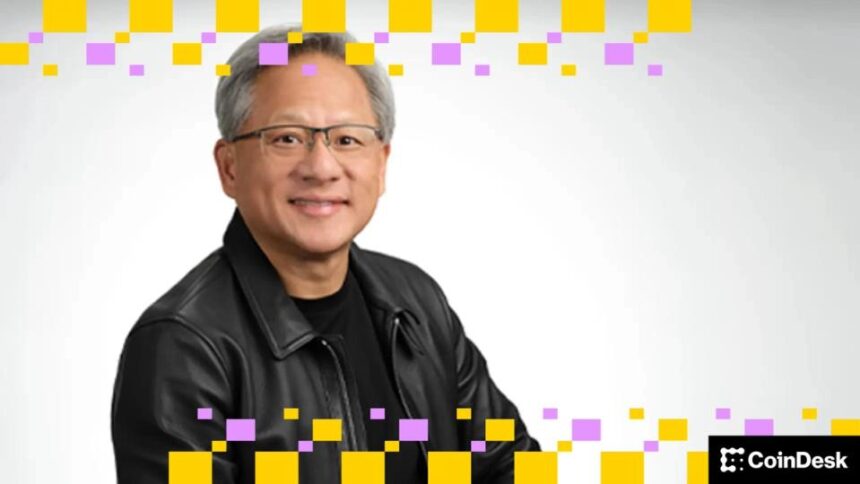
In a recent episode of The Joe Rogan Experience, Jensen Huang, CEO of Nvidia, shared his insights on the ongoing race for artificial intelligence (AI) supremacy, emphasizing that this competition cannot be narrowed down to a single groundbreaking event. Huang expressed that the current pursuit of AI leadership mirrors historical global tech races, citing examples from World War II to the Cold War, which have continually reshaped geopolitical dynamics.
Huang articulated that the evolution of AI is akin to the Manhattan Project but with a critical difference: the pace of advancement is gradual and incremental. He pointed out that, rather than a sudden breakthrough leading to a definitive conclusion, AI developments will manifest in continuous waves of progress that may be subtle in real-time but will become apparent as time progresses.
Despite the gradual nature of AI’s advancement, Huang conveyed the significance of these developments. He revealed that AI systems have seen an impressive growth in capability, becoming approximately 100 times more efficient in just the last two years. This rapid evolution has sparked widespread public concern regarding issues like autonomous weaponry and the risk of machines operating outside human ethical boundaries. However, Huang reassured his audience, arguing that much of the current momentum in AI is directed towards improving functionality and safety, thereby yielding more reliable and useful systems while minimizing errors.
During the conversation, Rogan raised common concerns about AI surpassing human judgment and the potential risks posed by quantum computing in undermining modern encryption methods. In response, Huang maintained that AI would consistently be “a click ahead.” He reminded listeners that throughout history, society has often panicked over emerging technologies, only to eventually adapt as these innovations became more comprehensible and subject to regulation.
Huang’s vision for the future does not center on a singular victor in the AI race; rather, he envisions a scenario where AI becomes an integral part of everyday infrastructure. He described a future where AI seamlessly integrates into various sectors, such as healthcare and transportation, evolving into a background companion that individuals rely on without even realizing its presence. This shift would signify a transformation where AI is not seen as a dominant force but as a foundational element of modern computing that simply functions effectively.