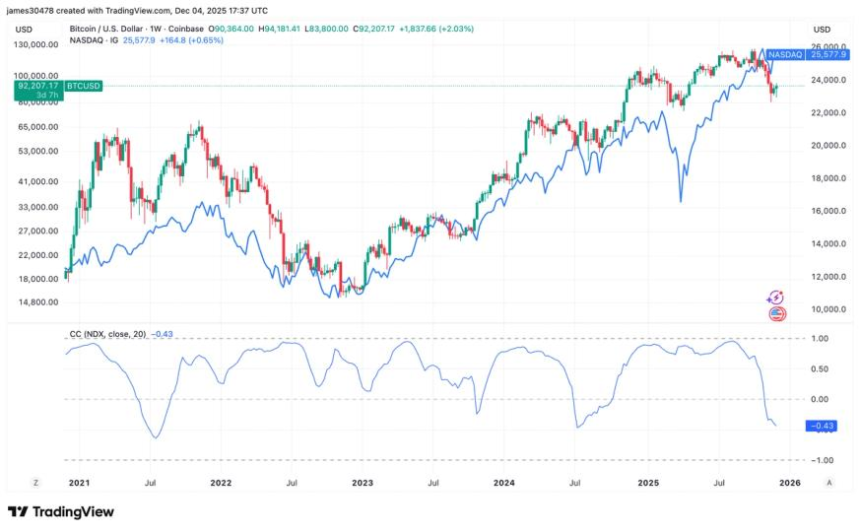
Bitcoin has recently displayed behaviors distinct from traditional risk assets, presenting what some analysts interpret as a significant divergence with potential implications for market trends. The cryptocurrency’s correlation with the Nasdaq 100 has turned negative, a relationship that historically has coincided with pivotal market reversals for Bitcoin.
Currently, the 20-day correlation coefficient between Bitcoin and the Nasdaq 100 is recorded at -0.43. This marks the fourth instance in the last five years where these two assets have entered negative territory, closely mirroring patterns observed during previous market lows. Such historical analogs include notable periods in summer 2021 and August 2024, both of which coincided with significant price troughs for Bitcoin.
Bitcoin has experienced notable volatility, plunging as much as 36% from its all-time high in October, contrasting sharply with the Nasdaq 100’s maximum drawdown of just 8%, as it now trades a mere 2% below its record high. Currently, Bitcoin is positioned 27% below its peak, indicating a slower recovery trajectory compared to the broader tech sector.
Past instances of negative correlation between Bitcoin and the Nasdaq 100 reveal a pattern where price declines have often led to local bottoms. For example, during a prior negative correlation phase, driven by the yen carry trade unwind, Bitcoin slipped to approximately $49,000, ultimately marking a local bottom. Similarly, in September 2023, Bitcoin hovered just below $30,000 before surging to $40,000 by year-end. The first recorded instance of this negative correlation occurred in May 2021 amidst a China mining ban that saw Bitcoin’s price plummet from $60,000 to $30,000, only to recover to new heights later that year.
Taken in context, these historical episodes suggest that the current negative correlation with the Nasdaq 100 may hint at another bottom forming for Bitcoin. However, despite these indicators, the timing and extent of any potential rebound remain uncertain. As analysts and investors closely monitor the market, the implications of this divergence could shape future trading strategies and outlooks for Bitcoin.