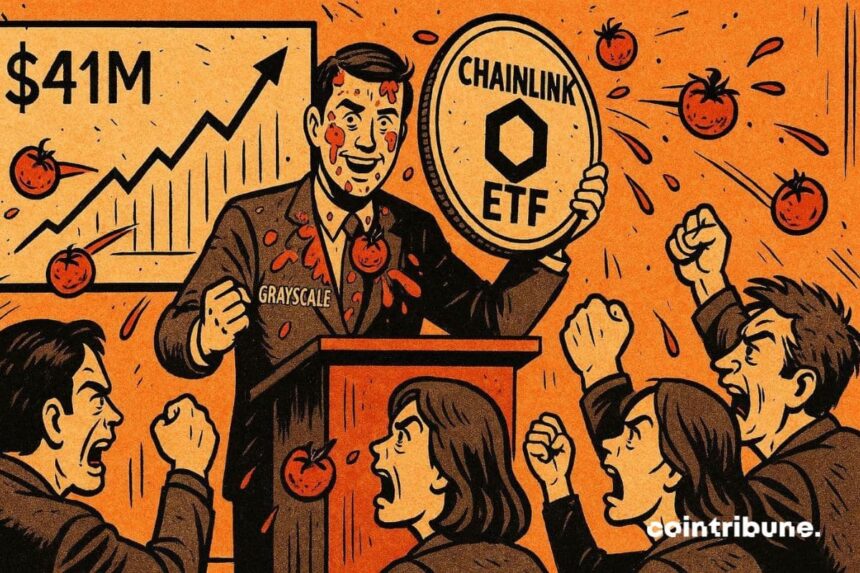
Grayscale’s recent launch of the Chainlink ETF has drawn significant attention, managing to attract $41 million in net inflows on its first day of trading. This move marked a significant step in the evolution of crypto exchange-traded funds (ETFs), particularly as it transitioned Grayscale’s Chainlink Trust into a spot ETF listed on the NYSE Arca under the ticker GLNK. With trading volumes reaching $13 million and total assets under management climbing to $64 million—including a foundational allocation of $18 million—these figures suggest a noteworthy interest from institutional investors.
However, despite these seemingly robust numbers, industry experts are hesitant to label the launch as a “blockbuster.” Comparisons have been drawn to other more successful crypto ETF launches, highlighting the relatively subdued performance of the Chainlink ETF. For instance, the XRP ETF was able to record an unprecedented $243 million in inflows on its first day, while the Solana ETF garnered just $8.2 million. This disparity points to a broader market context in which altcoins face challenges, particularly amid a prevailing “risk-off” sentiment among investors.
Although Chainlink has established itself as a significant infrastructure player within the cryptocurrency ecosystem, it remains a niche asset compared to larger cryptocurrencies like Bitcoin and Ethereum. Analysts suggest that while the ETF may attract institutional capital, it has yet to resonate with retail investors, limiting its potential to become a market-moving entity. Despite the initial inflows and a modest price increase of 7 to 9.8% for LINK over the week, the token’s value is still down 39% year-over-year, indicating existing resistance and a continuing bearish trend.
Conversely, the XRP ETF not only achieved remarkable inflows but also positively affected XRP’s price, showcasing that some ETF launches can indeed act as catalysts for market enthusiasm. Factors contributing to the XRP ETF’s success include its association with a high-profile lawsuit against the SEC, which generated significant buzz and engagement from the XRP community, alongside a period of renewed optimism for altcoins.
For the Chainlink ETF to realize its potential and transform into a “blockbuster,” it would require a confluence of favorable conditions. These may include a resurgence in investor confidence in altcoins, widespread adoption of Chainlink within the decentralized finance (DeFi) sector, and sustained inflow of investments into the ETF.
In summary, while the launch of Grayscale’s Chainlink ETF signifies growing institutional interest in regulated crypto products, it also underscores the challenges facing altcoin ETFs in a complex market landscape. The evolution of Chainlink’s performance and its ability to attract consistent investment flows will be critical determinants of its future success.