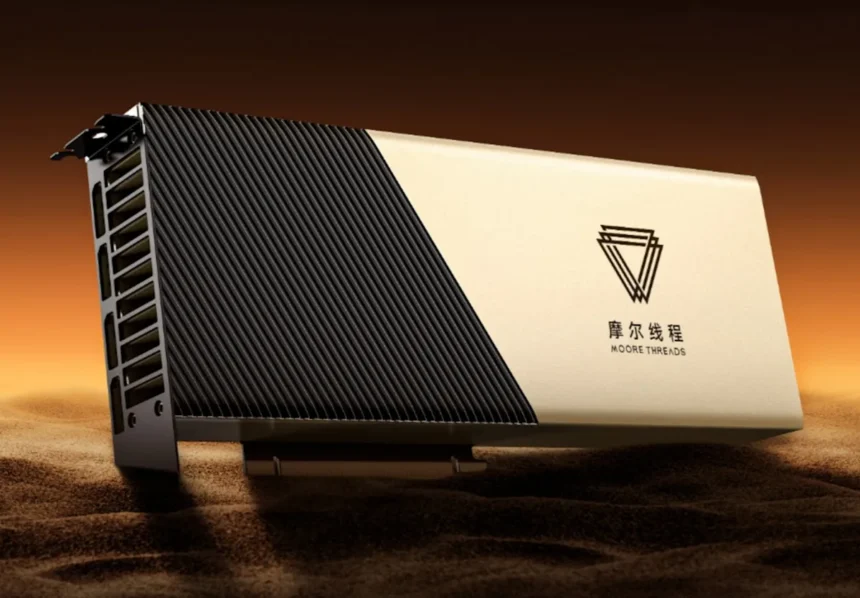
Moore Threads Technology experienced a significant surge in its stock prices, with shares skyrocketing over fivefold during its trading debut in Shanghai. This enthusiastic reception by investors comes as the Beijing-based semiconductor supplier has positioned itself prominently in the artificial intelligence arena, marking it as the second-largest trading debut in China’s stock market this year.
The company’s stock started trading at 650 yuan, reflecting an astonishing 468% increase from its initial public offering (IPO) price of 114.28 yuan, all amid a broader market downturn where China’s benchmark CSI300 Index recorded a slight decline of 0.1%. This impressive rise underscores China’s growing emphasis on technology self-sufficiency, part of a broader five-year plan aimed at economic and social development goals through 2030. In recent years, China has engaged in an escalating competition with the US in various tech sectors, including AI, advanced chips, and robotics.
Moore Threads successfully raised 8 billion yuan (approximately US$1.13 billion) in its IPO, making it the second-largest IPO in the mainland for the year, following Huadian New Energy Group’s US$2.7 billion IPO in July. The proceeds are set to finance the company’s initiatives focused on next-generation AI and graphics chips, while also supplementing working capital needs.
Nicknamed “China’s Nvidia,” Moore Threads experienced a rapid ascent to the capital market, receiving the necessary approvals from the China Securities Regulatory Commission in just four months after application—an impressive feat compared to the average processing time of around 470 days for applicants on the Shanghai Stock Exchange Science and Technology Innovation Board last year.
Liang Wenfeng, the founder of the large language model firm DeepSeek and quantitative hedge fund HighFlyer, emerged as one of the most notable institutional investors, reportedly investing 7 million yuan in Moore prior to its IPO.
Founded in 2020 by James Zhang Jianzhong and several veteran GPU engineers from Nvidia, Moore initially focused on GPUs for gaming and display purposes. It has since pivoted to developing AI accelerator chips targeted at the training and inference of large language models. Although the company reported about 70 million yuan in revenue during the first half of this year—exceeding its total revenue from the previous year—Moore Threads has yet to achieve profitability, with expectations of breaking even as early as 2027.
In contrast, another semiconductor firm, Guangdong Tianyu Semiconductor, faced a disappointing debut in Hong Kong, where its shares plummeted 34% from an IPO price of HK$58 to HK$38, despite being heavily oversubscribed.
This stark contrast in their market performances highlights the varying investor sentiments in China’s burgeoning semiconductor sector, especially in light of geopolitical shifts and U.S. restrictions placed on technology access for Chinese companies—which have forced firms like Moore to adapt their supply chain strategies.