







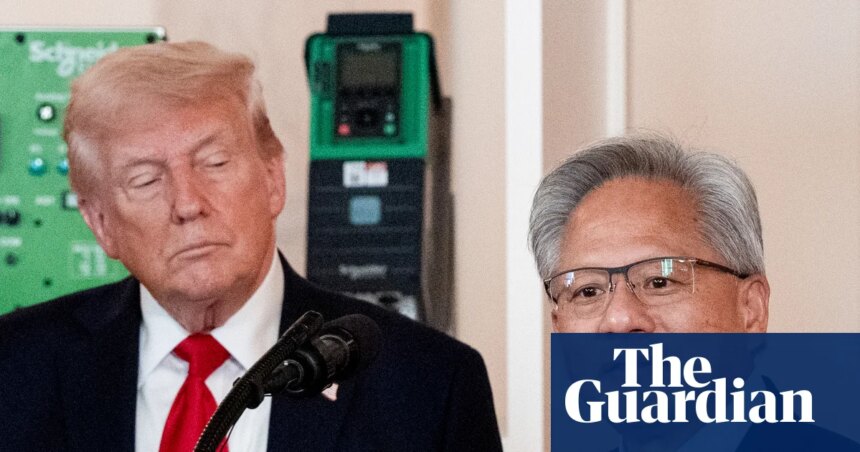
In a significant shift in U.S. policy, Donald Trump announced that Nvidia has received approval to sell its advanced AI computer chips to China, a move resulting in a major victory for the company and its CEO, Jensen Huang. This decision follows months of lobbying efforts by Huang to persuade the White House to lift restrictions that had previously barred the sale of Nvidia’s most sophisticated technology to Chinese buyers over national security concerns.
On a recent post on Truth Social, Trump stated, “I have informed President Xi, of China, that the United States will allow NVIDIA to ship its H200 products to approved customers in China, and other Countries, under conditions that allow for continued strong National Security.” He indicated that President Xi responded positively to this development. The announcement raises questions about the potential repercussions for national security and international trade.
The previous barrier against shipping Nvidia’s advanced H200 chips to China had left the tech giant unable to compete in one of the largest markets for AI technology. This shift allows Nvidia to re-enter this lucrative market, and could potentially yield billions of dollars, considering that the company is currently valued at approximately $4.5 trillion.
The details of the arrangement with the U.S. government reportedly involve a change in the financial terms, with Trump announcing that the U.S. will receive 25% of the proceeds from sales, an increase from the previously agreed 15%. This arrangement raises eyebrows, as it continues a trend of the federal government taking financial stakes in private sector operations, which has faced criticism from lawmakers.
Concerns surrounding this policy change have emerged from several quarters, with Democratic senators like Elizabeth Warren and Andy Kim expressing their apprehensions. In a letter to Commerce Secretary Howard Lutnick, they articulated their fears that the sale of these chips could bolster China’s surveillance and military capabilities. Warren has since called for Huang to testify before Congress regarding the implications of this decision.
Huang has maintained a close relationship with Trump, participating in various White House events and summits since the inauguration, and he has signaled intentions to invest significantly in AI infrastructure in the U.S. over the next four years. His efforts to engage with both U.S. and Chinese officials highlight the ongoing complexities of navigating international tech trade amid fluctuating regulations.
This latest announcement also comes on the heels of China imposing its own restrictions on the import of Nvidia products earlier this year. This back-and-forth in diplomacy and trade has greatly impacted Nvidia, as Huang has previously noted the substantial decline in the company’s share of the Chinese market due to ongoing bans.
In light of the announcement, a spokesperson for Nvidia expressed gratitude for the decision, emphasizing that the approved sale of H200 chips to vetted customers strikes a reasonable balance for the U.S. The spokesperson echoed Trump’s assurance that this move would bolster American jobs and manufacturing capabilities.
As Trump revives sales to China, he criticized the Biden administration’s stringent export controls, arguing that such policies hindered U.S. competitiveness in technology sectors. While Chinese authorities have yet to officially respond to this announcement, industry analysts observe that extended U.S. restrictions have inadvertently provided a space for China’s domestic chip development to flourish.
The unfolding scenario presents a complex interplay between economic interests and national security, with significant implications for both U.S. and Chinese technology sectors as they navigate this evolving landscape.


