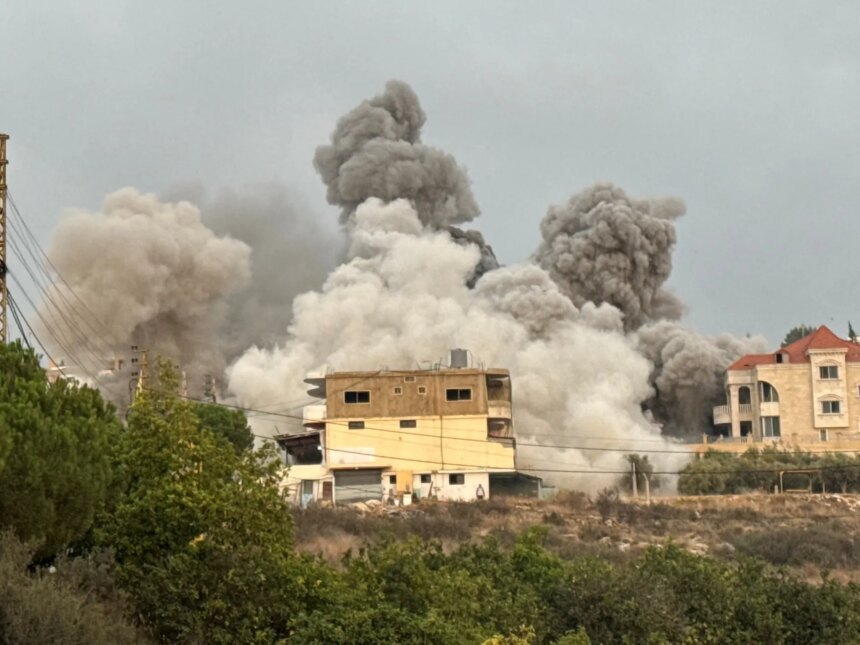
Israel’s military has intensified its air campaign in southern Lebanon, targeting multiple sites associated with Hezbollah, as reported by Lebanese state media. This escalation comes amid rising tensions regarding an existing ceasefire agreement brokered by the United States, which was established to halt hostilities that had persisted for over a year.
Reports from Lebanon’s National News Agency indicate that Israeli jets executed several waves of strikes, hitting key locations, including Mount Safi, the town of Jbaa, the Zefta Valley, and the area between Azza and Rumin Arki. While the extent of the damage to homes is notable, there have been no immediate reports of casualties following these strikes.
In a statement on X, the Israeli military confirmed the operations, claiming to have targeted various Hezbollah facilities, including a training compound used by the elite Radwan Force. The strikes reportedly involved the destruction of multiple buildings and a rocket-launching site.
This latest military action follows a recent effort by both Israel and Lebanon to engage in discussions through civilian envoys sent to a military committee responsible for monitoring the ceasefire. President Joseph Aoun of Lebanon has emphasized the nation’s commitment to negotiations with Israel, indicating that these talks aim to curb Israel’s ongoing military actions against Lebanon.
Since the ceasefire, which was established in 2024, Israel’s airstrikes have taken a heavy toll, with a United Nations report highlighting at least 127 civilian fatalities, including children. UN officials have characterized these ongoing strikes as potentially constituting war crimes.
Tensions escalated recently when an Israeli airstrike in Beirut’s southern suburbs resulted in the death of Hezbollah’s top military commander, Haytham Ali Tabtabai. While the group remains significantly weaker following last year’s conflict, it has yet to formally respond to this provocation.
Israel has criticized Lebanon for allegedly failing to pressure Hezbollah to disarm, a claim that the Lebanese government contests. Prime Minister Nawaf Salam has urged for a more effective role for the ceasefire monitoring mechanism, particularly in verifying Israel’s assertions regarding Hezbollah’s rearmament and assessing the efforts of the Lebanese army in dismantling Hezbollah’s infrastructure.
When questioned about the possibility of deploying US and French troops on the ground as part of a verification mechanism, Salam affirmed the potential for such an arrangement.
The ongoing Israeli airstrikes have heightened anxieties in Lebanon about a possible escalation of military actions, as Hezbollah maintains its stance of retaining arms in response to Israel’s continued incursions and occupation of territories in southern Lebanon.